Technical Guides
Why Won’t a Grease Fitting Take Grease? Causes, Diagnosis, and Solutions
October 16, 2026 · SENLITE Admin
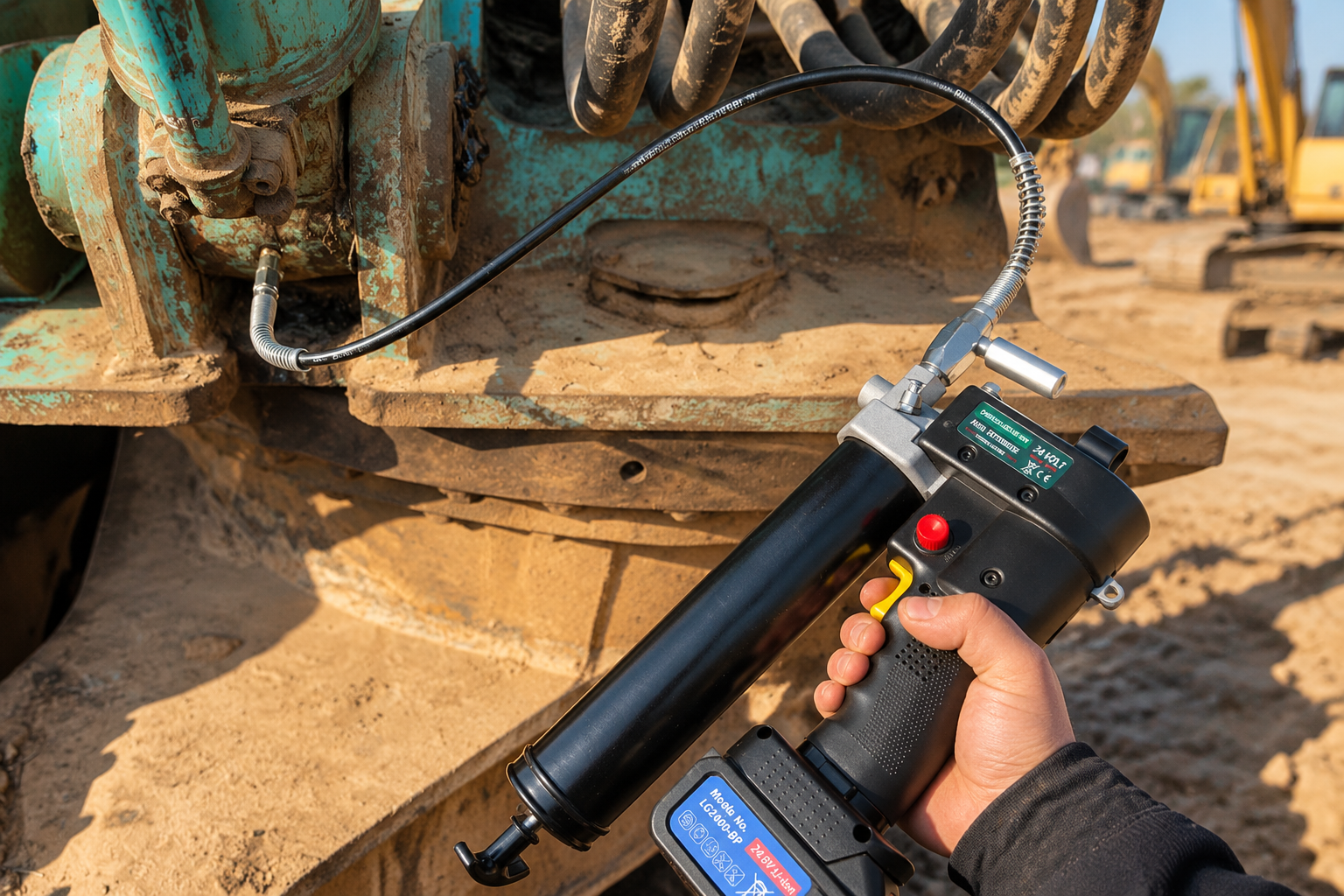
A grease fitting that will not accept grease is one of the most frustrating problems in equipment maintenance.
You connect the grease gun, pull the trigger, and expect fresh grease to enter the joint. Instead, pressure builds, grease does not move, or grease leaks around the coupler.
The first reaction is often to blame the grease gun.
That is not always correct.
If an electric grease gun works normally on other lubrication points but one particular fitting refuses to accept grease, the problem may be on the machine side rather than inside the grease gun.
The restriction can be inside the grease fitting, behind the fitting, or deeper inside the lubrication passage of a pin, bushing, bearing, or joint.
This guide explains the most common reasons a grease fitting will not take grease, how to separate a grease gun problem from a machine-side problem, and what professional maintenance teams should check before replacing equipment or applying excessive pressure.
## What Does It Mean When a Grease Fitting Won’t Take Grease?
A grease fitting, also called a grease nipple or Zerk fitting, provides an entry point for lubricant.
When the grease gun coupler is connected correctly, grease should pass through the fitting and into the lubrication passage.
If grease does not enter, one of several things may be happening.
The fitting itself may be damaged or blocked.
Old grease may have hardened inside the passage.
Dirt or other contamination may be restricting the lubrication path.
The joint or bushing may have an internal blockage.
The coupler may not be making a proper connection.
Or the grease gun may not be delivering grease correctly.
The important point is that these problems require different solutions.
Increasing pressure without identifying the cause is not a complete troubleshooting method.
## 1. The Grease Fitting Is Blocked
One of the simplest causes is a blocked grease fitting.
The small internal passage of a fitting can become restricted by:
- Hardened grease
- Dirt
- Dust
- Rust
- Contamination
- Dried lubricant residue
This is more likely when equipment operates in dusty, muddy or contaminated environments.
A grease fitting should be cleaned before connecting the grease gun.
Otherwise, contamination around the fitting can be pushed toward the lubrication system.
If the fitting itself is suspected to be blocked or damaged, inspection or replacement may be more appropriate than repeatedly applying pressure.
A new fitting is usually a much simpler problem to solve than a damaged machine component.
## 2. Hardened Grease Is Blocking the Passage Behind the Fitting
Replacing the grease fitting does not always solve the problem.
Sometimes the fitting is working correctly, but the passage behind it is blocked.
This can happen when old grease remains in the lubrication channel for a long period.
The problem can be especially difficult on:
- Excavator pins
- Loader pins
- Bucket linkages
- Bushings
- Pivot points
- Other heavily loaded joints
In these situations, the grease gun may generate pressure but the grease still cannot move through the restricted passage.
This is an important distinction:
A high-pressure grease gun can create pressure, but it cannot automatically repair a blocked mechanical passage.
If the fitting has been verified and the lubrication point still refuses grease, the internal passage may require further inspection according to the equipment manufacturer's service procedure.
## 3. The Lubrication Passage Inside the Pin or Bushing Is Restricted
Heavy equipment lubrication systems often contain drilled passages that carry grease from the fitting into the working area of a pin, bushing or joint.
If this passage becomes blocked, grease may stop entering the joint even though the grease fitting itself is functional.
This is one reason a single grease point can behave differently from all the others on the same machine.
For example:
- 10 grease points accept grease normally
- 1 grease point builds pressure immediately
- The grease gun works normally elsewhere
That pattern makes a localized restriction more likely.
It does not prove the exact cause, but it tells the technician where to investigate first.
## 4. The Grease Fitting Is Damaged
A grease fitting is a small component, but it has an important job.
A damaged fitting may:
- Fail to open correctly
- Leak grease
- Become contaminated
- Lose its ability to seal
- Prevent proper coupler engagement
Corrosion can also affect fittings exposed to water, mud and outdoor conditions.
If a fitting is visibly damaged, replacing it may be the correct first step.
However, replacing the fitting does not guarantee that the deeper lubrication passage is clear.
If the new fitting still will not accept grease, continue the diagnosis rather than repeatedly replacing the same part.
## 5. The Grease Coupler Is Not Connecting Correctly
The problem may not be the grease fitting at all.
The coupler is the connection between the grease gun hose and the machine fitting.
If the coupler does not lock onto the fitting correctly, grease may escape around the connection instead of entering the lubrication point.
Possible signs include:
- Grease leaking around the fitting
- Coupler repeatedly coming loose
- Difficulty locking onto the fitting
- Damaged or worn coupler jaws
- Excessive grease around the connection
Before assuming that the machine is blocked, inspect the coupler.
Make sure the connection is straight and secure.
A worn coupler can create a misleading symptom because the grease gun may be generating pressure normally while the connection is failing to transfer that pressure into the fitting.
## 6. The Grease Gun May Be the Real Problem
A grease fitting problem should not be diagnosed without considering the grease gun.
The fastest basic comparison is to test the same grease gun on another known-good lubrication point.
If grease flows normally from several other fittings, the grease gun is less likely to be the primary cause.
If the gun cannot deliver grease anywhere, investigate the gun itself.
Possible tool-side causes include:
- Air trapped in the grease path
- Incorrect grease loading
- Loss of prime
- Empty grease supply
- Blocked hose
- Coupler restriction
- Pump problem
- Battery or electrical problem
This simple comparison can prevent unnecessary disassembly of heavy equipment.
## 7. Cold or Highly Consistent Grease Can Increase Resistance
Temperature and grease characteristics can also affect pumping behavior.
Grease can become more difficult to move at low temperatures.
A lubricant that pumps normally in a warm workshop may behave differently in a cold outdoor environment.
The result can be:
- Slower grease delivery
- Higher resistance
- Longer priming time
- Increased motor load
- Difficulty moving grease through a restricted passage
However, cold grease should not automatically be blamed for every blocked fitting.
If one fitting refuses grease while other fittings work normally under the same conditions, a localized restriction still deserves investigation.
The grease must also be suitable for the equipment and operating conditions.
Always follow the equipment manufacturer's lubricant requirements.
## 8. The Joint May Be Under Mechanical Load
The condition of the machine can also affect a lubrication point.
Pins and bushings operate under mechanical loads.
Depending on the machine design and position of the attachment, the load distribution around a joint can change.
If a particular grease point suddenly becomes difficult to service, repositioning the equipment according to the manufacturer's maintenance procedure may help determine whether the joint condition is contributing to the resistance.
Do not place yourself in a dangerous position under a raised attachment simply to reach a grease fitting.
Machine positioning and maintenance safety procedures should always follow the equipment manufacturer's instructions.
## How to Diagnose a Grease Fitting That Won’t Take Grease
A systematic process is better than simply increasing pressure.
### Step 1: Clean the Grease Fitting
Remove dirt, old grease and visible contamination from around the fitting.
The objective is to prevent contamination from entering the lubrication system.
### Step 2: Check the Coupler
Inspect the coupler for:
- Dirt
- Hardened grease
- Wear
- Damage
- Poor engagement
Make sure it locks onto the fitting correctly.
### Step 3: Test the Grease Gun on Another Fitting
This is one of the most useful diagnostic steps.
If the gun delivers grease normally at another lubrication point, the problem is more likely to be associated with the original fitting or lubrication passage.
If the gun fails at multiple points, investigate the grease gun first.
### Step 4: Inspect the Fitting
If the fitting appears damaged, blocked or corroded, follow the equipment manufacturer's procedure for inspection or replacement.
Do not assume that a new fitting automatically means the internal passage is clear.
### Step 5: Check the Lubrication Passage
If the fitting is functional but grease still cannot enter, the restriction may be deeper inside the joint.
This can involve hardened grease or contamination in the passage, pin or bushing.
Further disassembly should follow the machine manufacturer's service instructions.
### Step 6: Stop Before Applying Excessive Force
A high-pressure grease gun is a powerful maintenance tool.
That does not mean the trigger should be held continuously against a suspected blockage.
If pressure rises quickly and grease still does not move, stop and diagnose the restriction.
The goal is to restore lubrication safely, not simply to achieve the highest possible pressure.
## Why More Pressure Is Not Always the Answer
This is an important point for professional equipment operators.
Suppose a grease fitting is completely blocked.
A stronger grease gun may generate more pressure, but the blockage itself has not disappeared.
If the fitting, hose, coupler or internal passage is damaged, excessive pressure can create another problem.
The correct sequence is:
Identify the restriction → inspect the affected component → correct the blockage → resume normal lubrication.
Pressure is a capability.
It is not a substitute for maintenance diagnosis.
## How to Tell Whether the Problem Is the Gun or the Machine
A simple comparison can help.
### The grease gun is probably working normally if:
- It pumps grease at other fittings
- Grease exits the coupler normally
- The motor operates normally
- The grease supply is adequate
- The problem occurs at only one or a few specific lubrication points
In this situation, inspect the machine-side components.
### The grease gun may require attention if:
- No grease comes out at any fitting
- The gun repeatedly loses prime
- The motor runs but grease does not reach the hose
- Grease supply is not feeding the pump
- The hose or coupler is restricted
- Abnormal noise or leakage is present
This distinction is especially useful for maintenance teams because it prevents them from replacing a working tool when the actual problem is a blocked lubrication point.
## Why Clean Grease Fittings Matter
A grease fitting is an entry point into the lubrication system.
If the outside of the fitting is covered with dirt, sand or hardened grease, that contamination can enter the lubrication path during servicing.
This is particularly important for:
- Excavators
- Wheel loaders
- Backhoe loaders
- Agricultural machinery
- Mining equipment
- Industrial machines
Before lubrication, clean the fitting.
After lubrication, remove excessive grease and contamination from the surrounding area.
Good lubrication is not simply about adding more grease.
It is also about controlling contamination.
## Should You Keep Pumping Until Grease Comes Out?
Not necessarily.
The correct amount of grease depends on the equipment, component and manufacturer's maintenance procedure.
Some maintenance procedures specify adding grease until fresh grease appears at a particular location, while others use specified quantities or intervals.
Over-greasing can also create problems.
Therefore, operators should follow the equipment manufacturer's instructions rather than using unlimited grease as a universal rule.
The objective is proper lubrication, not maximum grease consumption.
## What If a Grease Fitting Still Won’t Take Grease After Replacement?
If a new fitting is installed correctly and the lubrication point still will not accept grease, the problem may be deeper in the system.
Possible areas for inspection include:
- Internal grease passage
- Pin
- Bushing
- Bearing
- Joint configuration
- Mechanical alignment
- Hardened grease
- Contamination
At this stage, further troubleshooting should follow the equipment manufacturer's service information.
If disassembly is required, it should be performed by personnel qualified for the machine and repair procedure.
Do not assume that increasing grease gun pressure is a safe replacement for mechanical inspection.
## Preventing Grease Fitting Blockages
The best solution is to prevent the problem from developing.
Professional maintenance teams can reduce the risk by following several practices.
### Keep Fittings Clean
Clean the fitting before connecting the grease gun.
### Follow a Lubrication Schedule
Do not wait until a joint begins making noise before checking lubrication.
Follow the equipment manufacturer's recommended intervals.
### Use the Correct Grease
The grease should meet the machine manufacturer's requirements for the application.
### Protect Grease From Contamination
Keep grease containers and loading equipment clean.
Dust, water and other contaminants should be kept away from the lubricant.
### Inspect Fittings During Routine Maintenance
Look for:
- Corrosion
- Damage
- Missing fittings
- Leakage
- Hardened grease
- Abnormal grease buildup
A damaged fitting is easier to address during routine inspection than after the lubrication point has become completely restricted.
## Why This Problem Matters on Excavators
Excavators contain many grease points around moving joints and attachment systems.
These components operate under substantial mechanical loads and repeated movement.
If one lubrication point is missed repeatedly because it will not accept grease, the maintenance problem can become more serious over time.
That is why a blocked grease fitting should not simply be marked as "difficult" and ignored.
The correct approach is to identify why grease is not entering the lubrication point and repair the underlying problem.
## Electric Grease Guns and Blocked Lubrication Points
A cordless electric grease gun can make heavy-equipment maintenance more efficient because the operator does not need to repeatedly pump a manual lever.
For difficult lubrication points, adequate pressure capability can also be valuable.
However, the tool should be considered part of the complete lubrication system:
Grease → Grease Gun → Hose → Coupler → Grease Fitting → Lubrication Passage → Pin/Bushing/Bearing
A problem at any point in this chain can affect grease delivery.
This is why professional buyers should evaluate more than maximum PSI when selecting an electric grease gun.
Pressure, grease output, battery performance, hose design, coupler quality, grease-loading system and safety features all matter.
## SENLITE Electric Grease Guns for Professional Maintenance
Dezhou Senlite Electromechanical Equipment Co., Ltd. (SENLITE) specializes in the development and manufacturing of electric grease guns and industrial lubrication tools.
The current SENLITE electric grease gun range includes the SLT2100 and SLT2400.
The SLT2400 is a 24V electric grease gun with:
- Maximum working pressure up to 10,000 PSI
- 400 cc (14 oz) grease capacity
- Grease output up to 130 g/min
- LCD battery display
- Adjustable pressure
- Safety valve
- 700 mm high-pressure hose
These specifications make the SLT2400 suitable for professional lubrication applications involving construction equipment, heavy machinery and other demanding maintenance environments.
However, even a high-pressure electric grease gun should not be used as a substitute for diagnosing a blocked or damaged lubrication point.
The machine, lubricant, fitting, hose, coupler and grease gun should be treated as one complete lubrication system.
## Frequently Asked Questions
### Why won't my grease fitting take grease?
The fitting may be blocked or damaged, the passage behind it may contain hardened grease or contamination, or the coupler may not be connecting correctly. If the grease gun works normally on other fittings, investigate the affected lubrication point first.
### Why does my grease gun build pressure but no grease enters the fitting?
This can indicate a restriction at the fitting or deeper inside the lubrication passage. It can also be caused by a coupler problem. Stop applying excessive pressure and diagnose the system.
### How do I know if the grease fitting or grease gun is blocked?
Test the grease gun on another known-good fitting. If grease flows normally there, the original fitting or lubrication point is more likely to be the source of the problem.
### Should I replace a grease fitting that won't take grease?
If the fitting is damaged, corroded or blocked, replacement may solve the problem. If a new fitting still will not accept grease, the blockage may be deeper inside the lubrication passage.
### Can a high-pressure grease gun clear a blocked fitting?
High pressure can help with some resistant lubrication points, but it is not a universal solution. A blocked or damaged fitting or internal passage should be diagnosed rather than continuously pressurized.
### Why does an excavator grease fitting become blocked?
Common contributing factors include hardened old grease, contamination, insufficient maintenance, damaged fittings and restrictions inside the lubrication passage. The exact cause depends on the machine and lubrication point.
### Can cold weather make a grease fitting harder to service?
Yes. Lower temperatures can increase grease resistance and make pumping more difficult. However, if only one fitting refuses grease while other points work normally, a localized restriction should also be investigated.
### What should I do if one grease point never accepts grease?
Do not simply skip the point. Clean and inspect the fitting, check the coupler, test the grease gun elsewhere, and follow the equipment manufacturer's service procedure if the lubrication passage remains restricted.
## Final Takeaway
When a grease fitting will not take grease, the problem is not automatically the grease gun.
The fitting itself may be blocked or damaged. Hardened grease or contamination may be restricting the passage behind the fitting. The coupler may not be connecting correctly, or the problem may be deeper inside a pin, bushing or joint.
The most effective troubleshooting process is simple:
Clean the fitting → check the coupler → test the grease gun elsewhere → inspect the fitting → investigate the lubrication passage if necessary.
Most importantly, do not confuse high pressure with correct maintenance.
A professional electric grease gun should provide the pressure and grease delivery needed for the application, but reliable lubrication ultimately depends on the entire system working correctly.
Related products
Related articles
Electric Grease Gun vs Automatic Lubrication System: Which Is Better for Heavy Equipment?
Compare electric grease guns with automatic lubrication systems for heavy equipment. Learn about cost, maintenance, flexibility, lubrication control, and how to choose the right solution.
Will Any 14 oz Grease Cartridge Fit an Electric Grease Gun?
Learn how to check 14 oz grease cartridge compatibility, barrel dimensions, loading methods, and grease specifications before using an electric grease gun.
Grease Gun Coupler Types Explained: How to Choose the Right One for Heavy Equipment
Learn how to choose the right grease gun coupler for heavy equipment. Compare standard, locking, button-head and flush couplers, with tips on fitting compatibility, pressure ratings and safe use.