Technical Guides
Grease Gun Coupler Types Explained: How to Choose the Right One for Heavy Equipment
October 21, 2026 · SENLITE Admin
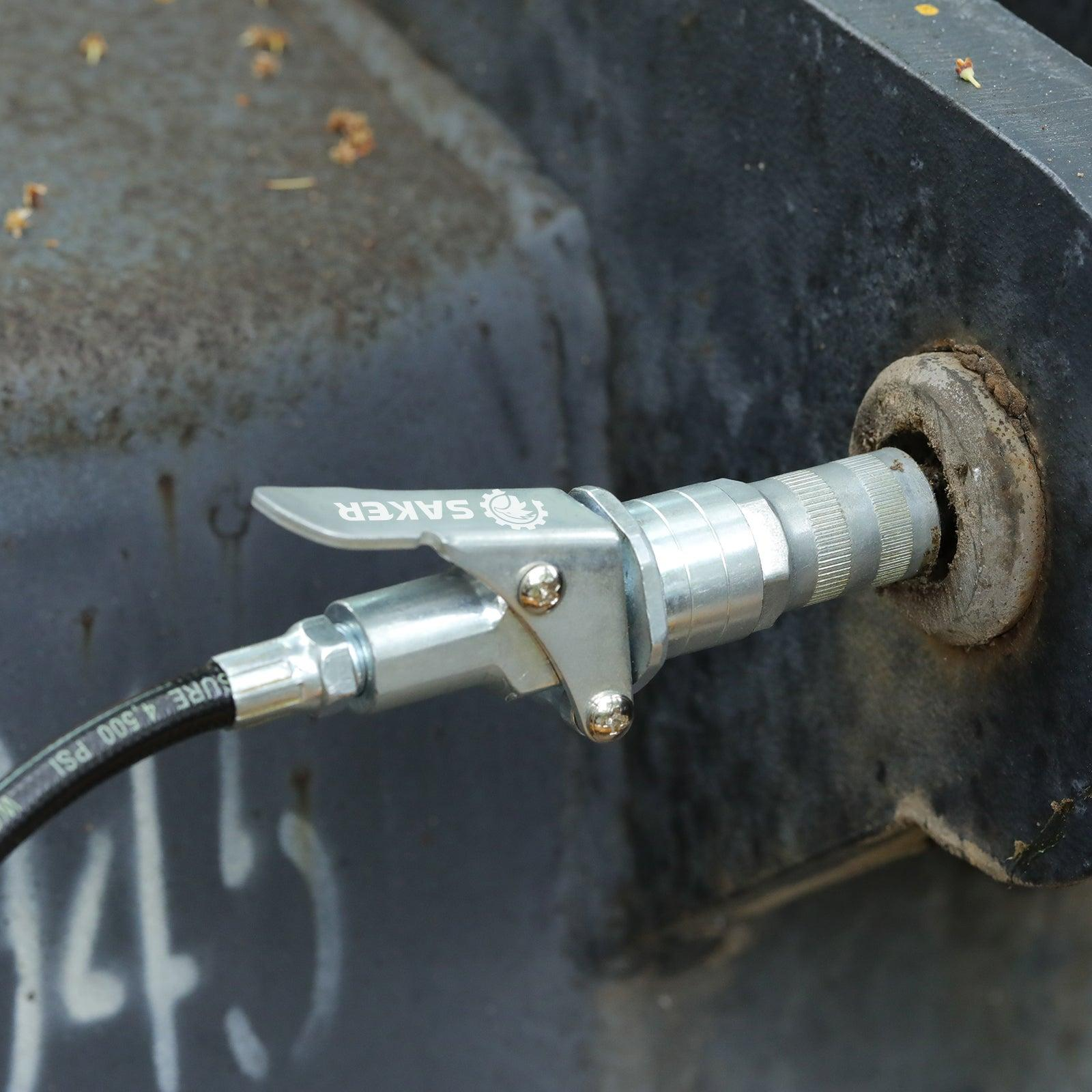
A grease gun can have sufficient pressure and grease output, yet lubrication can still be difficult if the coupler does not match the grease fitting on the machine.
This is a common issue in heavy equipment maintenance. Excavators, wheel loaders, agricultural machinery, and industrial equipment may use different grease fitting designs depending on the component, manufacturer, and application.
Choosing the correct grease gun coupler helps create a secure connection, reduce grease leakage, improve access to lubrication points, and make routine maintenance more efficient.
However, not every coupler fits every grease fitting. Pressure ratings, connection threads, fitting geometry, and working conditions must all be considered.
This guide explains the main types of grease gun couplers, how they differ, and what professional buyers should check before selecting accessories for an electric grease gun.
What Is a Grease Gun Coupler?
A grease gun coupler is the component at the end of a grease gun hose or extension that connects to a grease fitting on a machine.
When the connection is suitable and properly engaged, grease passes through the coupler and enters the equipment's lubrication passage.
A coupler must perform two important functions:
Maintain a suitable connection with the grease fitting during lubrication.
Allow grease to pass through the connection without unacceptable leakage.
The coupler is a relatively small component, but it directly affects how easily a technician can service a lubrication point.
A poorly matched or worn coupler may leak, disconnect during pumping, or become difficult to attach and remove.
For professional users, choosing the correct coupler is therefore part of selecting a complete lubrication system, not merely an accessory decision.
1. Standard Grease Gun Couplers
Standard grease gun couplers are widely used for conventional grease fittings, commonly called Zerk fittings or grease nipples.
Many conventional designs use spring-loaded internal jaws that grip the fitting head when the coupler is pushed into position.
These couplers are commonly supplied with manual, pneumatic, and electric grease guns, although the exact design and pressure rating vary.
Advantages
Suitable for many conventional grease fittings.
Simple and familiar to maintenance technicians.
Available in different dimensions and connection configurations.
Useful for general workshop and field maintenance.
Limitations
A standard coupler may need to be held in position while grease is being delivered.
If the fitting is worn, the connection is misaligned, or the coupler jaws are damaged, leakage or poor engagement may occur.
Standard couplers also vary in maximum working pressure. A coupler intended for a manual grease gun should not automatically be assumed suitable for a high-pressure electric model.
Best applications
Standard couplers are a practical choice when equipment uses conventional grease fittings that are accessible and in good condition.
Before selecting one, verify its fitting compatibility, thread connection, and working-pressure rating.
2. Locking Grease Gun Couplers
A locking grease gun coupler uses a locking mechanism to secure the connection to a compatible grease fitting.
Depending on the design, a lever, sleeve, or other release mechanism controls the gripping jaws.
Once correctly attached, the coupler can remain connected without the operator continuously holding it in place.
Advantages
Can provide a more secure connection during lubrication.
May reduce the need to hold the coupler manually.
Can help reduce leakage caused by poor positioning when the connection is compatible and properly engaged.
Can be useful when servicing multiple lubrication points.
Limitations
A locking coupler must still match the fitting and the grease gun's operating requirements.
Some designs are bulkier than standard couplers, which may make access difficult in confined spaces.
The release procedure also varies by design. A locking coupler should not be pulled off forcibly or disconnected while the system remains pressurized.
Best applications
Locking couplers may be useful for maintenance teams that perform frequent lubrication work and need a secure connection during pumping.
For excavators and other heavy equipment, consider whether the coupler can reach the actual grease fittings without placing excessive force on the hose.
3. Quick-Connect Grease Gun Couplers
Quick-connect couplers are designed to make attachment and removal more convenient.
Many use a mechanism that opens or releases the gripping jaws through a lever or sleeve.
The exact design depends on the manufacturer, and the terms "locking coupler" and "quick-connect coupler" may overlap in product descriptions.
Do not select a coupler based on its name alone. Check how the connection locks, how it releases, and which fittings it supports.
Advantages
Can simplify repeated attachment and removal.
May improve workflow when servicing many grease points.
Can reduce time spent handling conventional threaded or push-on connections.
Important considerations
Quick connection does not automatically mean universal compatibility.
The coupler must still match the fitting profile, the grease gun connection, and the intended pressure.
For professional purchasing, ask the supplier for the exact coupler specification rather than relying on a generic "quick-connect" description.
4. Button-Head Grease Couplers
Button-head grease fittings have a broader, flatter head than conventional Zerk fittings.
They require a compatible button-head coupler designed to engage the fitting correctly.
A standard coupler should not be assumed suitable for a button-head fitting.
Button-head fittings are used in some heavy-duty applications, including equipment where the fitting design and servicing method are selected for particular working conditions.
Advantages
Designed specifically for compatible button-head fittings.
Can provide a suitable connection for equipment using this fitting style.
Available in different sizes for different fitting designs.
Limitations
Button-head couplers must match the fitting dimensions and configuration.
A coupler designed for one button-head size may not fit another. Buyers should verify the exact fitting standard and dimensions before ordering replacement accessories.
Best applications
Choose a button-head coupler when the equipment is fitted with a compatible button-head grease fitting.
Do not try to force a conventional coupler onto an incompatible fitting.
5. Flush-Style Grease Couplers and Nozzles
Some lubrication points use flush-style grease fittings that sit nearly level with the surrounding surface.
These fittings may not have the projecting head required by a conventional coupler.
A compatible flush-style coupler or nozzle is designed to engage the appropriate fitting profile.
The correct selection depends on the actual fitting design and the access available around it.
What buyers should consider
The shape and dimensions of the flush fitting.
Whether there is sufficient space for the nozzle.
The pressure rating of the accessory.
Whether the nozzle is intended for the specific grease gun and application.
Do not assume that every pointed nozzle is suitable for every flush fitting.
Some specialized nozzles have very small outlets and require particular care when used with high-pressure equipment.
6. Needle Nozzles and Angled Adapters
Needle nozzles and angled adapters serve different purposes from conventional couplers.
A needle nozzle can help deliver grease into a compatible small lubrication opening where a standard coupler cannot be used.
A right-angle adapter or swivel adapter can help reach fittings positioned behind brackets, inside restricted spaces, or at awkward angles.
These accessories do not automatically replace the coupler required for a conventional grease fitting.
Needle nozzles
Needle nozzles are useful only when the lubrication point is designed or suitable for that delivery method.
Because the outlet may be very small, pressure can rise rapidly if grease cannot escape into the intended passage.
Use only accessories rated for the application and follow the manufacturer's safety instructions.
Never direct a pressurized nozzle toward your skin or use your hand to check for grease flow.
Angled and swivel adapters
These accessories can improve access without requiring the operator to bend the hose sharply.
However, each additional component introduces another connection that must be compatible with the tool and suitable for the operating pressure.
Before using an adapter, verify its connection threads, working-pressure rating, and intended application.
Grease Gun Coupler Types Compared
The following table summarizes the main differences.
Coupler or accessoryPrimary purposeImportant selection factorStandard couplerConnect to conventional grease fittingsFitting profile and pressure ratingLocking couplerSecure the connection during pumpingLocking mechanism and release methodQuick-connect couplerSimplify attachment and removalCompatibility and connection designButton-head couplerConnect to button-head fittingsFitting size and profileFlush-style couplerConnect to suitable flush fittingsFitting geometry and accessNeedle nozzleDeliver grease through a compatible small openingApplication suitability and pressure ratingRight-angle or swivel adapterImprove access to difficult lubrication pointsClearance, threads, and pressure rating
These categories are not always mutually exclusive. Some couplers combine locking and quick-connect features, while adapters may be used with a compatible base coupler.
The correct choice depends on the fitting and the maintenance task.
How to Choose the Right Grease Gun Coupler
Choosing a coupler should begin with the equipment's actual grease fitting, not the accessory catalogue.
Step 1: Identify the Grease Fitting
Determine whether the machine uses a conventional Zerk fitting, button-head fitting, flush fitting, or another design.
If the fitting type is uncertain, check the equipment manual or consult the manufacturer.
Do not assume that fittings on different machines are identical.
Step 2: Check Access to the Lubrication Point
A fitting may be standard but difficult to reach.
Consider whether the coupler can be attached straight, whether there is enough clearance around the fitting, and whether an angled adapter or swivel would improve access.
Avoid arrangements that force the hose into a sharp bend or place excessive sideways force on the connection.
Step 3: Verify the Thread Connection
The coupler must connect correctly to the grease gun hose or extension.
Common thread configurations include NPT and BSP variants, but the actual thread depends on the tool and accessory.
Do not assume that two threads are interchangeable simply because they appear similar or have comparable dimensions.
Check the thread type, size, and gender specified by the manufacturer before ordering.
Never force a mismatched thread into place.
Step 4: Check the Working-Pressure Rating
Pressure rating is one of the most important selection criteria for an electric grease gun coupler.
The coupler, hose, adapters, and other pressure-carrying components must be suitable for the maximum pressure they may experience in the intended setup.
Do not select a coupler based only on its advertised burst pressure. Burst pressure is not the same as maximum working pressure.
For example, the SENLITE SLT2400 has a maximum working pressure of up to 10,000 PSI. Buyers selecting a replacement coupler or adapter for this model should verify that the accessory's specified working-pressure rating is suitable for the application.
The pressure rating of the included coupler should also be confirmed from the actual product specification rather than assumed from the grease gun's pressure rating.
Step 5: Consider How Often the Tool Will Be Used
A technician who services one machine occasionally may have different requirements from a maintenance team servicing a large fleet every day.
For frequent use, consider:
Ease of connection and release.
Resistance to wear.
Availability of replacement couplers.
Compatibility with the equipment fleet.
Ease of cleaning and inspection.
Support from the tool supplier.
The best coupler is the one that matches the application reliably, not necessarily the one with the most complicated mechanism.
Step 6: Confirm Replacement Availability
For distributors and B2B buyers, replacement accessories affect long-term product usability.
Before placing a bulk order, ask whether compatible couplers, hoses, adapters, and other service parts are available.
Also confirm whether replacement components use the same connection specifications as the supplied configuration.
Why Does a Grease Gun Coupler Leak?
Leakage around a coupler can have several causes.
Common possibilities include:
The coupler is not fully engaged.
The coupler does not match the fitting.
Internal jaws or sealing surfaces are worn.
The fitting head is damaged.
The hose connection is loose or damaged.
Pressure exceeds the rating of a component.
A blockage or restriction is causing abnormal resistance.
If leakage occurs, stop operating the grease gun and make the system safe according to the manufacturer's instructions before inspecting the connection.
Do not tighten or loosen pressure-carrying components while the system remains pressurized.
If the coupler or fitting is damaged, replace or service it according to the applicable instructions.
Why Does a Grease Gun Coupler Get Stuck?
A coupler that will not release may be affected by pressure in the grease delivery system, excessive adjustment, worn fitting geometry, contamination, or poor alignment.
A stuck coupler does not automatically mean that the grease gun is defective.
Stop the tool and follow the manufacturer's pressure-release procedure before attempting removal.
Then use the release method specified for that coupler design. Do not pull harder on the hose or loosen a pressurized connection as an improvised solution.
If the problem happens repeatedly, inspect the coupler and fitting for wear, damage, or incompatibility.
Safety Considerations for High-Pressure Grease Gun Accessories
A grease gun can generate enough pressure to cause a serious injection injury.
For this reason, coupler selection and maintenance should include pressure safety.
Follow these practices:
Use couplers and adapters rated for the intended working pressure.
Inspect hoses and connections before use.
Do not operate damaged or leaking accessories.
Stop the tool if grease flow becomes unexpectedly restricted.
Relieve pressure according to the manufacturer's procedure before disconnecting.
Never check a leak with your hand.
Seek emergency medical care immediately if grease is injected into the skin, even if the wound appears small.
A compatible coupler improves connection quality, but it does not remove the need for safe operating procedures.
What B2B Buyers Should Ask a Grease Gun Supplier
For importers, distributors, repair workshops, and equipment-maintenance companies, accessory specifications should be confirmed before ordering.
Useful questions include:
Which grease fitting types does the supplied coupler support?
What are the coupler's connection thread specifications?
What is its maximum working-pressure rating?
Are compatible replacement couplers and hoses available?
Are alternative couplers or adapters available for different applications?
What is the correct pressure-release and removal procedure?
Can the supplier provide written specifications and operating instructions?
These questions help prevent avoidable compatibility problems after delivery.
They are particularly important for buyers serving customers with mixed equipment fleets, where multiple grease fitting styles may be present.
SENLITE Electric Grease Guns for Professional Lubrication
Dezhou Senlite Electromechanical Equipment Co., Ltd. (SENLITE) specializes in the development and manufacturing of electric grease guns and industrial lubrication tools.
The current electric grease gun range includes the SLT2100 and SLT2400.
The SLT2400 is a 24V electric grease gun with maximum working pressure up to 10,000 PSI, a 400 cc (14 oz) grease capacity, and grease output up to 130 g/min.
For professional users, these specifications should be considered together with the hose, coupler, fitting compatibility, and operating procedure.
Buyers evaluating a cordless electric grease gun should confirm the accessory configuration supplied with the selected model and verify compatibility with their intended equipment.
For distributors and wholesale customers, clear product specifications and access to suitable replacement accessories can support more reliable long-term service.
Frequently Asked Questions
Are all grease gun couplers the same?
No. Couplers differ in fitting compatibility, connection design, locking mechanism, dimensions, and working-pressure rating. A coupler designed for a conventional Zerk fitting may not fit a button-head or flush-style fitting.
What is the difference between a standard and a locking grease gun coupler?
A standard coupler commonly uses internal jaws to grip a conventional grease fitting. A locking coupler adds a mechanism designed to secure the connection during pumping. The exact design, pressure rating, and release method depend on the manufacturer.
What is a button-head grease coupler used for?
It is designed to connect to compatible button-head grease fittings. The coupler must match the fitting's dimensions and profile.
Can I use a quick-connect coupler on an electric grease gun?
Potentially, provided the coupler is compatible with the grease gun connection, the intended grease fitting, and the operating pressure. Confirm all specifications before use.
How do I know whether a coupler can handle 10,000 PSI?
Check its specified maximum working-pressure rating in the manufacturer's documentation. Do not use burst pressure as a substitute for working pressure, and do not assume that every accessory supplied with a grease gun has the same pressure rating as the tool.
Why does grease leak around the coupler?
Possible causes include incomplete engagement, a mismatched or damaged fitting, worn coupler jaws, a damaged hose connection, or abnormal pressure caused by a restriction. Stop the tool and inspect the connection after making the system safe.
Which grease gun coupler is best for excavator maintenance?
There is no single best coupler for every excavator. The correct choice depends on the grease fitting design, access, working pressure, maintenance frequency, and the coupler's compatibility with the tool.
Conclusion
Choosing the right grease gun coupler starts with identifying the grease fitting and confirming that the accessory matches the application.
Standard couplers, locking couplers, button-head couplers, flush-style couplers, needle nozzles, and angled adapters each serve different purposes.
For professional maintenance, the most important factors are fitting compatibility, thread specifications, working-pressure rating, accessibility, durability, and safe release procedures.
A suitable coupler helps technicians connect the grease gun correctly and complete lubrication work more reliably. For B2B buyers, verifying these details before purchasing can reduce compatibility issues and improve the long-term usability of the complete lubrication system.
Related products
Related articles
Electric Grease Gun vs Automatic Lubrication System: Which Is Better for Heavy Equipment?
Compare electric grease guns with automatic lubrication systems for heavy equipment. Learn about cost, maintenance, flexibility, lubrication control, and how to choose the right solution.
Will Any 14 oz Grease Cartridge Fit an Electric Grease Gun?
Learn how to check 14 oz grease cartridge compatibility, barrel dimensions, loading methods, and grease specifications before using an electric grease gun.
Grease Gun Coupler Stuck on a Zerk Fitting? How to Release It Safely
Is your grease gun coupler stuck on a Zerk fitting? Learn safe removal techniques, common causes, troubleshooting steps, and ways to prevent coupler problems during heavy equipment maintenance.