Technical Guides
Why Does a Grease Gun Coupler Get Stuck on a Zerk Fitting? Causes, Safe Release and Prevention
September 30, 2026 · SENLITE Admin
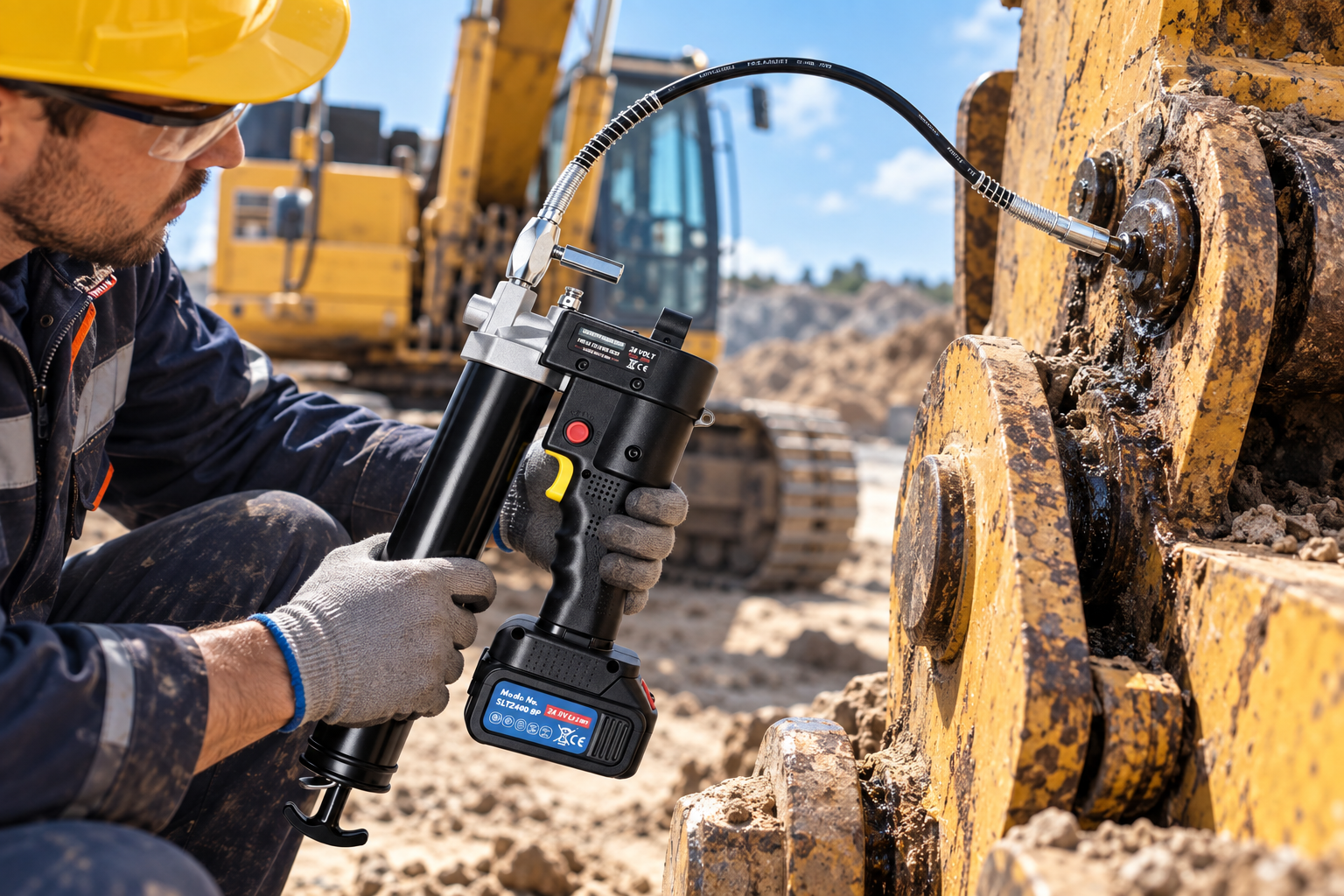
A grease gun coupler that refuses to release from a zerk fitting can turn a routine lubrication job into a frustrating maintenance problem.
This is especially noticeable when using a high-pressure electric grease gun on excavators, loaders, agricultural machinery, trucks and other heavy equipment. The operator finishes pumping grease, tries to remove the coupler, and discovers that it is gripping the fitting much more tightly than expected.
Pulling harder is not necessarily the answer.
A stuck grease coupler can be a sign of trapped pressure, a blocked lubrication passage, an incorrectly adjusted coupler, worn components or a damaged grease fitting. More importantly, grease guns operate at pressures high enough to create a serious fluid-injection hazard if hoses, fittings or connections are damaged or handled incorrectly.
The correct approach is therefore to understand why the coupler is stuck before trying to force it off.
Why Does a Grease Gun Coupler Get Stuck?
A standard grease coupler uses internal jaws to grip the head of a grease fitting.
When the coupler is correctly connected, grease travels through a path similar to this:
Grease Gun → High-Pressure Hose → Coupler → Zerk Fitting → Lubrication Passage → Pin, Bushing or Bearing
If grease can move through the complete path normally, connecting and disconnecting the coupler should generally be straightforward.
Problems begin when resistance increases somewhere downstream.
The grease gun continues generating pressure, but the grease cannot move freely into the lubrication point. Pressure can then remain trapped between the grease gun, hose, coupler and fitting.
That pressure can increase the force acting on the coupler connection and make the coupler difficult to remove.
This is why a stuck coupler should not automatically be treated as a coupler problem.
The real restriction may be inside the machine.
1. A Blocked Zerk Fitting Can Create High Back Pressure
One of the first things to investigate is the grease fitting itself.
Heavy equipment works in environments where fittings are exposed to:
Dust
Mud
Water
Old grease
Corrosion
Mechanical damage
A grease fitting contains a small internal check mechanism that allows grease to enter while helping prevent contamination and lubricant from moving back out.
If the fitting becomes blocked or damaged, fresh grease may not pass through normally.
The operator may notice several symptoms:
The grease gun builds pressure quickly
Little or no grease enters the joint
Grease leaks around the coupler
A pressure-relief system activates
The coupler becomes unusually difficult to remove
When these symptoms appear together, simply increasing pressure may make the situation worse.
The lubrication point needs diagnosis.
2. The Fitting May Be Good but the Grease Passage Can Still Be Blocked
Replacing the zerk fitting does not always solve the problem.
The fitting may allow grease through when removed from the machine, while the pin, bushing or internal grease passage behind it remains blocked.
This is a real issue on older construction and agricultural equipment.
Old grease can combine with dirt and contamination, and grease passages that have not been serviced correctly may become increasingly difficult to lubricate.
A useful diagnostic distinction is:
Does the fitting itself accept grease?
and
Does the complete lubrication passage accept grease?
Those are not the same question.
If a removed fitting passes grease normally but the installed lubrication point does not, the restriction may be deeper inside the machine.
At that stage, continuing to apply more grease-gun pressure is not a substitute for mechanical inspection.
3. Residual Pressure Can Keep the Coupler Locked
A grease gun does not necessarily become pressure-free the moment the trigger is released.
Pressure may remain in the hose and at the coupler, particularly when the connected lubrication point is highly resistant.
This residual pressure can make a standard coupler grip the zerk fitting tightly.
The important response is not to pull violently on the hose.
Stop operating the grease gun and follow the pressure-release procedure specified for the particular grease gun and coupler system.
Different grease guns and couplers use different pressure-control and release designs. Some electric grease guns include dedicated pressure-relief features, while some couplers use their own mechanical release mechanism.
The correct release method should therefore be based on the actual equipment design rather than a universal shortcut.
Never loosen a pressurized threaded hose connection simply to make the coupler release.
4. Coupler Adjustment Can Be Too Tight
Some conventional grease couplers allow the gripping tension to be adjusted.
If the coupler is adjusted too tightly, the internal jaws may grip the zerk fitting so aggressively that removal becomes difficult even when the lubrication point is functioning normally.
If it is adjusted too loosely, the opposite problem can occur:
Poor sealing
Grease leakage
Coupler slipping off
Difficulty building pressure
The objective is therefore not maximum gripping force.
It is a secure connection that seals correctly and can still be released as designed.
If the coupler is adjustable, follow the coupler manufacturer's instructions rather than repeatedly tightening it whenever leakage occurs.
Leakage can also be caused by worn jaws, contamination or a damaged fitting.
5. Worn Coupler Jaws Can Cause Both Leakage and Release Problems
Grease couplers are wear components.
Every time the coupler is pushed onto and removed from a fitting, the internal gripping components experience mechanical contact.
Over time, the jaws and sealing surfaces can wear.
A worn coupler may:
Leak grease around the fitting
Grip inconsistently
Slip off under pressure
Require excessive force to connect
Become difficult to release
Professional maintenance teams should therefore inspect the coupler rather than treating it as a permanent component that never requires replacement.
A high-quality electric grease gun cannot compensate for a badly worn connection at the end of the hose.
6. A Damaged Zerk Fitting Can Also Trap the Coupler
The grease fitting itself should be inspected for physical damage.
A deformed, corroded or partially damaged fitting can prevent the coupler jaws from moving normally.
This is particularly relevant on heavy equipment where grease fittings may be located close to moving structures or exposed to impact.
Before connecting the grease gun, inspect the fitting and clean away dirt and hardened grease.
If the fitting is visibly damaged, replacing it may be more appropriate than forcing a coupler onto it.
What Should You Do When a Coupler Will Not Release?
The safest approach is systematic.
First, stop pumping.
Do not continue pulling the trigger in an attempt to “push through” the problem.
Second, keep hands and other body parts away from suspected leaks, damaged hose sections and pressurized connections.
Third, use the pressure-release procedure specified by the grease gun and coupler manufacturer.
Once the system is safely depressurized, inspect:
The coupler
The zerk fitting
The hose
The connection
The lubrication passage
If the coupler has its own designed release mechanism, use that mechanism according to its instructions.
Do not improvise by loosening pressurized components.
If pressure cannot be safely relieved or the condition of the hose, fitting or coupler is uncertain, stop using the equipment until it can be inspected properly.
Why High-Pressure Grease Requires Respect
A grease gun may look like a relatively simple maintenance tool, but the grease delivery system operates under significant pressure.
High-pressure grease escaping from a damaged hose or connection can penetrate skin.
The external wound from a fluid-injection injury can appear small even when significant internal tissue damage has occurred.
For that reason:
Never search for a grease leak with your hand
Never place fingers over a coupler outlet
Never continue using a visibly damaged high-pressure hose
Never substitute an unverified hose or fitting simply because the threads appear to match
Never assume a small high-pressure injection injury is harmless
A suspected high-pressure grease injection injury requires immediate professional medical attention.
This safety issue matters even more as cordless electric grease guns become more powerful and convenient to use.
The trigger may require little physical effort, but the pressure generated at the hose and coupler can still be substantial.
How to Diagnose the Problem Before Blaming the Grease Gun
A professional troubleshooting process separates the tool from the lubrication point.
Consider four questions.
Does the grease gun deliver grease when disconnected from the machine?
If not, investigate the grease gun itself, including grease supply, priming, hose and coupler condition.
Does the problem occur on every zerk fitting?
If the grease gun works normally on most fittings but fails on one specific point, the machine fitting or lubrication passage deserves closer inspection.
Does grease leak around the coupler?
This may indicate poor coupler engagement, worn jaws, contamination, a damaged fitting or excessive back pressure.
Does pressure rise immediately without grease entering the joint?
A restriction downstream of the coupler may be preventing normal grease flow.
This diagnostic process avoids a common mistake: assuming that every lubrication problem means the electric grease gun is defective.
Coupler Design Matters When Choosing a Grease Gun
Maximum PSI attracts attention on product specifications, but the coupler is where the tool physically meets the machine.
For professional buyers, coupler evaluation should include:
Secure engagement
Reliable sealing
Compatibility with common grease fittings
Ease of connection
Ease of release
Access to recessed lubrication points
Pressure rating appropriate for the grease gun
A coupler that leaks, slips or becomes difficult to remove can reduce productivity even when the pump itself performs well.
This is particularly important for technicians servicing many grease points during one maintenance cycle.
Hose Specification Matters Too
The hose carries pressurized grease between the pump and coupler.
Inspect it regularly for:
Cuts
Abrasion
Cracking
Kinks
Bulging
Leakage
Damaged end fittings
Replacement hoses should meet the requirements of the grease gun and the intended application.
Do not assume that any flexible hose with compatible threads is suitable for a high-pressure grease gun.
For example, the SENLITE SLT2400 uses a 700 mm high-pressure hose rated to 12,000 PSI, while the grease gun has a maximum working pressure of 10,000 PSI.
This relationship between tool pressure and hose specification is important when evaluating a complete lubrication system.
Preventing Coupler Problems During Heavy Equipment Maintenance
Prevention starts before the trigger is pressed.
Clean the grease fitting before connecting the coupler.
Inspect the coupler and hose.
Connect the coupler squarely to the fitting.
Use the grease recommended for the equipment and working conditions.
If grease refuses to enter a lubrication point, diagnose the restriction instead of continuously increasing pressure.
After lubrication, release the coupler according to the tool and coupler manufacturer's procedure.
These habits help protect the grease gun, the fitting and the machine being serviced.
They also make lubrication work more predictable.
What Should B2B Buyers Evaluate?
For distributors, maintenance companies and professional buyers, a cordless grease gun should be evaluated as a complete system rather than by battery voltage or maximum PSI alone.
Important questions include:
What is the maximum working pressure?
What is the grease output rate?
What pressure is the supplied hose rated for?
How is residual pressure released?
What coupler is supplied?
Can the coupler be replaced easily?
How easy is the gun to prime?
What happens when a lubrication point is blocked?
Are replacement hoses and couplers available?
What safety features are built into the grease gun?
These questions reveal much more about real-world usability than a single pressure number.
SENLITE Electric Grease Guns for Professional Lubrication
Dezhou Senlite Electromechanical Equipment Co., Ltd. manufactures SENLITE electric grease guns and industrial lubrication tools for professional maintenance applications.
The current SENLITE electric grease gun range includes the SLT2100 and SLT2400.
The SLT2400 is a 24V cordless electric grease gun with a maximum working pressure of 10,000 PSI, a 400 cc (14 oz) grease capacity and grease output up to 130 g/min.
Its 700 mm high-pressure hose is rated to 12,000 PSI.
For professional users, these specifications should be considered together with the complete lubrication system: pump, pressure control, hose, coupler, grease fitting and machine lubrication passage.
A powerful grease gun is useful only when the complete system can deliver grease safely and reliably.
Frequently Asked Questions
Why does my grease gun coupler get stuck on a zerk fitting?
Common causes include residual hydraulic pressure, a blocked grease fitting or lubrication passage, an overly tight coupler, worn coupler jaws or a damaged zerk fitting.
Why does the coupler become harder to remove after pressure builds?
Pressure trapped in the grease delivery system can increase the load at the coupler-to-fitting connection. Stop pumping and use the pressure-release procedure specified for the grease gun and coupler before attempting removal.
Does a stuck coupler mean the grease gun is defective?
Not necessarily. If the gun works correctly on other fittings, the problem may be a blocked or damaged fitting, restricted lubrication passage or coupler issue.
Why does grease leak around the zerk fitting instead of going into the machine?
Possible causes include poor coupler engagement, worn coupler jaws, contamination, a damaged fitting or excessive resistance downstream of the fitting.
Should I keep increasing pressure if a grease fitting will not accept grease?
No. A fitting that refuses grease should be diagnosed. More pressure does not correct every blockage and can increase stress on hoses, couplers, fittings and other components.
Is a high-pressure grease gun dangerous?
High-pressure lubrication equipment must be used correctly. Pressurized grease escaping from a damaged hose or fitting can cause injection injuries. Inspect pressure-carrying components, follow manufacturer procedures and seek immediate medical treatment for any suspected injection injury.
Conclusion
A grease gun coupler stuck on a zerk fitting is not simply an annoying connection problem.
It can reveal what is happening inside the complete lubrication system.
Residual pressure, blocked fittings, restricted grease passages, coupler adjustment, wear and fitting damage can all contribute to the problem.
For heavy equipment maintenance, the correct response is not to apply maximum force or maximum pressure.
It is to identify where the resistance is coming from, safely remove stored pressure according to the equipment instructions, inspect the connection and correct the underlying cause.
That approach protects the operator, the grease gun and the machine being maintained.
Related products
Related articles
Electric Grease Gun vs Automatic Lubrication System: Which Is Better for Heavy Equipment?
Compare electric grease guns with automatic lubrication systems for heavy equipment. Learn about cost, maintenance, flexibility, lubrication control, and how to choose the right solution.
Will Any 14 oz Grease Cartridge Fit an Electric Grease Gun?
Learn how to check 14 oz grease cartridge compatibility, barrel dimensions, loading methods, and grease specifications before using an electric grease gun.
Grease Gun Coupler Types Explained: How to Choose the Right One for Heavy Equipment
Learn how to choose the right grease gun coupler for heavy equipment. Compare standard, locking, button-head and flush couplers, with tips on fitting compatibility, pressure ratings and safe use.