Technical Guides
What Is an Electric Grease Gun and How Does It Work? A Complete Guide
August 28, 2026 · SENLITE Admin
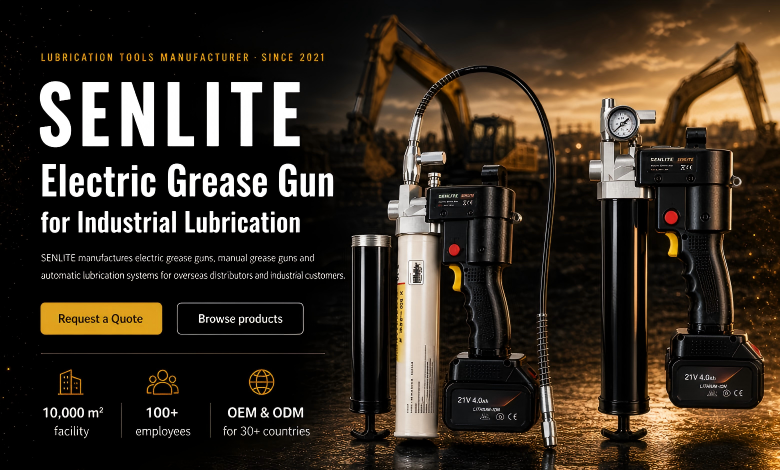
An electric grease gun is a powered lubrication tool designed to deliver grease to bearings, joints, pins, bushings, and other lubrication points through grease fittings. Instead of requiring the operator to repeatedly pump a lever by hand, an electric grease gun uses an electric motor and pumping mechanism to move grease from the barrel through a high-pressure hose and into the lubrication point.
Most portable electric grease guns used for equipment maintenance are cordless and powered by rechargeable batteries. This combination of portability and powered grease delivery makes them useful in workshops, factories, farms, vehicle fleets, construction sites, and other locations where machinery requires regular lubrication.
Although an electric grease gun may appear to be a relatively simple maintenance tool, its actual performance depends on several systems working together. The battery supplies electrical energy, the motor converts that energy into mechanical movement, the pump develops pressure and moves grease, and the hose and coupler deliver the lubricant to the grease fitting.
Understanding this process is useful not only for equipment operators but also for distributors, importers, maintenance companies, and B2B buyers evaluating electric grease guns.
What Is the Main Purpose of an Electric Grease Gun?
The primary purpose of an electric grease gun is to make grease lubrication faster and less physically demanding.
Many machines contain lubrication points where grease must periodically be introduced to reduce friction and protect moving components. Depending on the equipment, these points may be located around bearings, pivot pins, joints, bushings, steering components, chassis parts, or other mechanical assemblies.
A manual grease gun can perform the same fundamental task, but the operator must generate the pumping action manually. With an electric model, pulling the trigger activates a powered pumping system.
This becomes particularly useful when maintenance personnel need to service many lubrication points during the same maintenance cycle.
Electric grease guns are therefore commonly associated with applications such as:
Construction equipment
Agricultural machinery
Trucks and commercial vehicles
Fleet maintenance
Factory machinery
Industrial equipment
Mining and material-handling equipment
Workshop maintenance
The exact grease gun configuration should always be selected according to the equipment, lubrication requirements, grease type, fittings, and working conditions.
How Does an Electric Grease Gun Work?
The basic working process can be understood as a sequence:
Battery → Electric Motor → Drive Mechanism → Pump → Pressurized Grease → Hose → Coupler → Grease Fitting → Lubrication Point
When the operator presses the trigger, electrical energy from the battery powers the motor. The motor drives the internal pumping mechanism, which moves grease from the grease barrel toward the outlet.
As the grease travels through the pumping system, pressure is generated. The pressurized grease then passes through the outlet, high-pressure hose, and coupler.
When the coupler is correctly connected to a compatible grease fitting, grease is delivered into the lubrication passage of the machine.
This powered process is the main difference between an electric grease gun and a traditional hand-operated grease gun. Both are designed to deliver grease, but the source of pumping energy is different.
Electric grease guns use motor-driven pumping rather than relying on repeated manual lever or pistol-grip operation. General maintenance guidance similarly describes electric models as trigger-operated, typically rechargeable battery-powered tools that perform the same fundamental lubrication task while reducing repeated hand pumping. O'Reilly Auto Parts
What Are the Main Components of an Electric Grease Gun?
Although designs vary between manufacturers and models, a typical cordless electric grease gun contains several important functional components.
1. Rechargeable Battery
The battery supplies electrical power to the grease gun.
Battery voltage alone should not be treated as a complete measure of grease gun performance. Actual tool performance also depends on the motor, pumping mechanism, electronic design, battery capacity, operating load, and overall system efficiency.
For B2B buyers, battery availability and replacement support are also important because the battery is a service component that may need replacement during the working life of the tool.
2. Electric Motor
The motor converts electrical energy from the battery into mechanical movement.
This movement drives the grease pumping mechanism. Motor performance must therefore be considered together with the mechanical transmission and pump rather than evaluated as an isolated component.
3. Pumping Mechanism
The pump is responsible for moving and pressurizing grease.
This is one of the most important functional areas of the grease gun because lubrication systems may require grease to pass through relatively narrow passages and fittings.
The entire pressure path—including the pump, seals, hose, fittings, and connections—needs to operate as a system.
4. Grease Barrel
The grease barrel stores the grease supply before it enters the pumping mechanism.
Depending on the design, grease guns may support cartridge loading, bulk filling, or other loading methods. Buyers should verify the actual loading system of the specific model rather than assuming that every electric grease gun accepts the same grease container or cartridge format.
5. High-Pressure Hose
The flexible hose carries pressurized grease from the gun to the lubrication point.
Hose flexibility and length influence how easily operators can reach fittings located behind wheels, under machinery, around suspension components, or inside equipment structures.
Major cordless grease gun designs demonstrate why hose accessibility is treated as an important functional feature; current professional models advertise flexible hoses specifically for reaching difficult lubrication points. 密尔沃基工具
6. Grease Coupler
The coupler connects the grease gun hose to the grease fitting on the equipment.
A secure connection is important because the grease needs to pass from the hose into the fitting while the system is under pressure.
Coupler compatibility, sealing, wear, and ease of connection can therefore influence the user's experience even when the grease gun itself is functioning correctly.
7. Trigger and Controls
The trigger starts and stops grease delivery.
Depending on the model, additional controls may be provided for functions such as flow adjustment, speed selection, battery indication, work lighting, or other model-specific features.
These functions should always be evaluated according to the actual product specification rather than assumed to be standard on every electric grease gun.
Why Do Electric Grease Guns Need Pressure?
Grease is much thicker than many liquid lubricants. Moving it through a hose, coupler, fitting, and internal lubrication passage requires pressure.
This is why PSI—pounds per square inch—is frequently shown as a grease gun specification.
However, one of the most common mistakes when comparing electric grease guns is assuming:
Higher maximum PSI automatically means a better grease gun.
That is too simplistic.
Pressure describes the force available to move grease against resistance. But real lubrication work also depends on flow rate, grease viscosity, temperature, fitting condition, hose and coupler condition, equipment design, and the amount of grease that needs to be delivered.
Current professional cordless grease guns illustrate this distinction clearly: manufacturers publish both maximum pressure and flow specifications, and some models provide multiple operating speeds rather than treating pressure as the only performance measure. 密尔沃基工具
For industrial buyers, pressure should therefore be evaluated as part of the entire lubrication system—not as an isolated marketing number.
What Is Grease Gun Flow Rate?
If pressure describes the ability to overcome resistance, flow rate describes how quickly grease can be delivered.
This distinction is important.
A maintenance application involving many lubrication points or larger grease requirements may benefit from higher delivery speed. Another application may require more controlled grease delivery.
Therefore:
Pressure and flow rate are related performance specifications, but they answer different questions.
Pressure asks:
Can the system move grease against the resistance encountered at the lubrication point?
Flow rate asks:
How quickly can the grease gun deliver grease under its specified operating conditions?
For distributors and professional buyers, evaluating both values gives a more meaningful picture than comparing maximum PSI alone.
How Is Grease Loaded Into an Electric Grease Gun?
The exact loading method depends on the grease gun design.
Common grease gun systems may use cartridges, bulk grease, or loader-based filling systems. Some products support more than one method.
With a cartridge-type system, the general process involves opening the grease barrel, installing the correct cartridge according to the manufacturer's instructions, reassembling the barrel, removing trapped air, and priming the gun before use.
Priming is important because trapped air can interrupt grease delivery. Maintenance instructions for grease guns commonly emphasize removing trapped air and establishing consistent grease flow before normal operation. NAPA Blog
Operators should always follow the instructions for the specific model because barrel design, cartridge dimensions, seals, air-bleeding systems, and loading procedures can differ.
For importers and distributors, grease-loading compatibility is also a purchasing consideration. A grease gun intended for one market should be checked against the grease packaging and service practices commonly used by customers in that market.
Why Does an Electric Grease Gun Need to Be Primed?
A grease gun is designed to pump grease, not air.
If air becomes trapped inside the grease path after loading or changing grease, the pumping mechanism may operate without producing normal grease flow.
This situation is commonly described as an air lock or loss of prime.
Priming removes trapped air and helps establish a continuous path of grease between the barrel and pumping system.
Depending on the grease gun design, the procedure may involve an air bleeder, loosening and retightening part of the barrel assembly, or following another manufacturer-specified priming process.
A grease gun that runs but does not dispense grease is therefore not automatically suffering from a failed motor or pump. Air in the system should be one of the conditions checked during troubleshooting.
Electric Grease Gun vs. Manual Grease Gun: What Is the Difference?
Both tools have the same basic objective: delivering grease into a lubrication point.
The major difference is how pumping force is generated.
A manual grease gun requires physical movement from the operator. An electric grease gun uses a battery-powered motor and pump.
Manual grease guns can remain practical for occasional maintenance, simple jobs, and situations where batteries or charging are undesirable.
Electric grease guns become more attractive when maintenance involves frequent lubrication, numerous grease fittings, larger equipment, or repetitive work.
The decision should therefore be based on application rather than assuming one technology is universally better.
This topic deserves a separate detailed comparison because purchase frequency, maintenance environment, portability, workload, cost, and operator preference can all affect the choice.
Where Are Electric Grease Guns Commonly Used?
Electric grease guns can be used wherever compatible equipment requires grease lubrication and powered delivery provides a practical advantage.
Construction Equipment
Excavators, loaders, and other construction machines can contain multiple pins, joints, and bushings requiring scheduled lubrication.
Agricultural Machinery
Tractors, harvesters, implements, and other agricultural equipment often operate in environments where regular lubrication is an important part of preventive maintenance.
Trucks and Fleet Maintenance
Commercial vehicles and fleet equipment may contain multiple service points. For technicians maintaining many vehicles, reducing repetitive manual pumping can improve workflow.
Industrial Machinery
Factories and maintenance departments may use grease guns for bearings, mechanical joints, and other grease-lubricated components.
Workshops and Service Operations
Repair shops can use electric grease guns when frequent lubrication jobs make powered grease delivery more practical than repeated manual operation.
The appropriate grease, lubrication interval, quantity, and procedure should always follow the equipment manufacturer's requirements.
What Should B2B Buyers Evaluate in an Electric Grease Gun?
For importers, distributors, wholesalers, and private-label brands, evaluating an electric grease gun requires more than checking its appearance.
Important areas include:
Pressure performance
Grease flow
Battery system
Motor and pumping system
Hose and coupler quality
Sealing and leakage control
Grease-loading compatibility
Priming design
Ergonomics
Accessories
Replacement parts
Quality-control procedures
Packaging
OEM/ODM requirements
Target-market requirements
Buyers should also distinguish between a specification printed on a sales sheet and a specification supported by a repeatable test method.
For example, asking only:
“What is the maximum pressure?”
provides less information than asking:
“How is maximum pressure tested, under what conditions, and what inspection method is used during production?”
That distinction becomes increasingly important when sourcing products for repeat B2B orders.
Why Manufacturing Quality Matters
An electric grease gun operates as an interconnected system.
A strong motor cannot compensate for a poor seal. A high advertised pressure cannot compensate for an unreliable hose. A large battery cannot solve problems caused by an inefficient pump. A well-designed grease gun can still create customer complaints if assembly consistency is poor.
For this reason, professional evaluation should consider the complete product:
Battery + Motor + Transmission + Pump + Sealing System + Barrel + Hose + Coupler + Assembly + Testing
For manufacturers, quality control therefore needs to cover both individual components and completed-product performance.
For distributors, this is especially important because consistency between production batches affects warranty costs, customer satisfaction, and long-term product reputation.
How SENLITE Approaches Electric Grease Gun Manufacturing
Dezhou Senlite Electromechanical Equipment Co., Ltd. (SENLITE) is a China-based manufacturer of electric grease guns, grease guns, and industrial lubrication tools.
SENLITE integrates product development, manufacturing, sales, and export support. The company has 128 employees, including a 20-person R&D department, and operates a manufacturing base of more than 10,000 square meters.
Its products are supplied to international markets including the United States, France, Russia, Southeast Asia, and other regions.
For B2B customers, understanding how an electric grease gun works is useful before discussing product specifications or customization. Pressure, flow, battery configuration, grease-loading method, hose design, accessories, packaging, and target application can all influence which product configuration is appropriate.
SENLITE works with overseas importers, distributors, tool brands, and other B2B customers on electric grease gun and lubrication tool projects, including OEM and ODM requirements.
The objective is not simply to provide a specification list, but to match product configuration and manufacturing requirements to the intended market and application.
Frequently Asked Questions About Electric Grease Guns
What is an electric grease gun?
An electric grease gun is a powered lubrication tool that uses an electric motor and pumping mechanism to deliver grease through a hose and coupler into grease fittings and lubrication points. Portable models are commonly powered by rechargeable batteries.
How does a cordless grease gun work?
A cordless grease gun uses energy from its battery to power an electric motor. The motor drives a pumping mechanism that moves and pressurizes grease. The grease then travels through the hose and coupler into a connected grease fitting.
Is an electric grease gun the same as a battery-powered grease gun?
In the portable-tool market, the terms are frequently used to describe the same general product category: a grease gun powered by a rechargeable battery rather than manual pumping or compressed air. However, buyers should still check the actual power system and specifications of the individual product.
Why is PSI important on an electric grease gun?
PSI describes pressure. Sufficient pressure is required to move grease through the grease gun, hose, fitting, and lubrication passage against resistance. However, maximum PSI should not be used as the only measure of product performance.
What is the difference between pressure and flow rate?
Pressure relates to the grease gun's ability to overcome resistance, while flow rate relates to how quickly grease is delivered. Both should be evaluated according to the intended lubrication task.
Why is my electric grease gun running but not pumping grease?
One possible cause is trapped air or loss of prime, particularly after loading grease. Other possibilities can include grease supply, blockage, coupler or fitting problems, or model-specific mechanical issues. Troubleshooting should follow the manufacturer's instructions rather than assuming the motor or pump has failed.
What equipment can an electric grease gun be used on?
Depending on the grease gun, grease, fittings, and equipment requirements, electric grease guns may be used for construction machinery, agricultural equipment, trucks, fleet vehicles, industrial machinery, and workshop maintenance. Always follow the equipment manufacturer's lubrication specifications.
Final Thoughts
An electric grease gun is more than a battery-powered replacement for a manual lever. It is a lubrication system in which the battery, motor, pumping mechanism, pressure path, grease barrel, hose, coupler, and controls must work together.
Its basic operating principle is straightforward:
Electrical energy powers the motor, the motor drives the pump, the pump pressurizes the grease, and the grease travels through the hose and fitting to the lubrication point.
Understanding that process makes it easier to evaluate specifications correctly.
Maximum PSI alone does not define a good electric grease gun. Pressure, flow, battery performance, grease-loading compatibility, hose and coupler design, sealing, ergonomics, manufacturing consistency, and the intended application all matter.
For B2B buyers, distributors, and importers, this system-level understanding is especially valuable. It helps separate meaningful product specifications from isolated marketing numbers and provides a better foundation for product selection, sample testing, OEM/ODM discussions, and long-term sourcing decisions.
Related products
Related articles
How to Maintain an Electric Grease Gun: Cleaning, Battery Care and Storage Guide
Learn how to maintain an electric grease gun with practical guidance on cleaning, battery care, hose and coupler inspection, grease contamination prevention and proper storage.
Why Is My Electric Grease Gun Not Pumping Grease? 8 Common Causes and Solutions
Electric grease gun running but not pumping grease? Learn 8 common causes, including air locks, blocked fittings, coupler problems, thick grease, battery issues and loss of prime, with a practical troubleshooting process.
How to Choose an Electric Grease Gun for Excavators and Heavy Equipment
Learn how to choose an electric grease gun for excavators and heavy equipment by comparing pressure, flow rate, battery, hose, coupler, grease capacity and real maintenance requirements.