Technical Guides
How to Load and Prime an Electric Grease Gun: Cartridge, Bulk Filling and Air Removal Guide
August 31, 2026 · SENLITE Admin
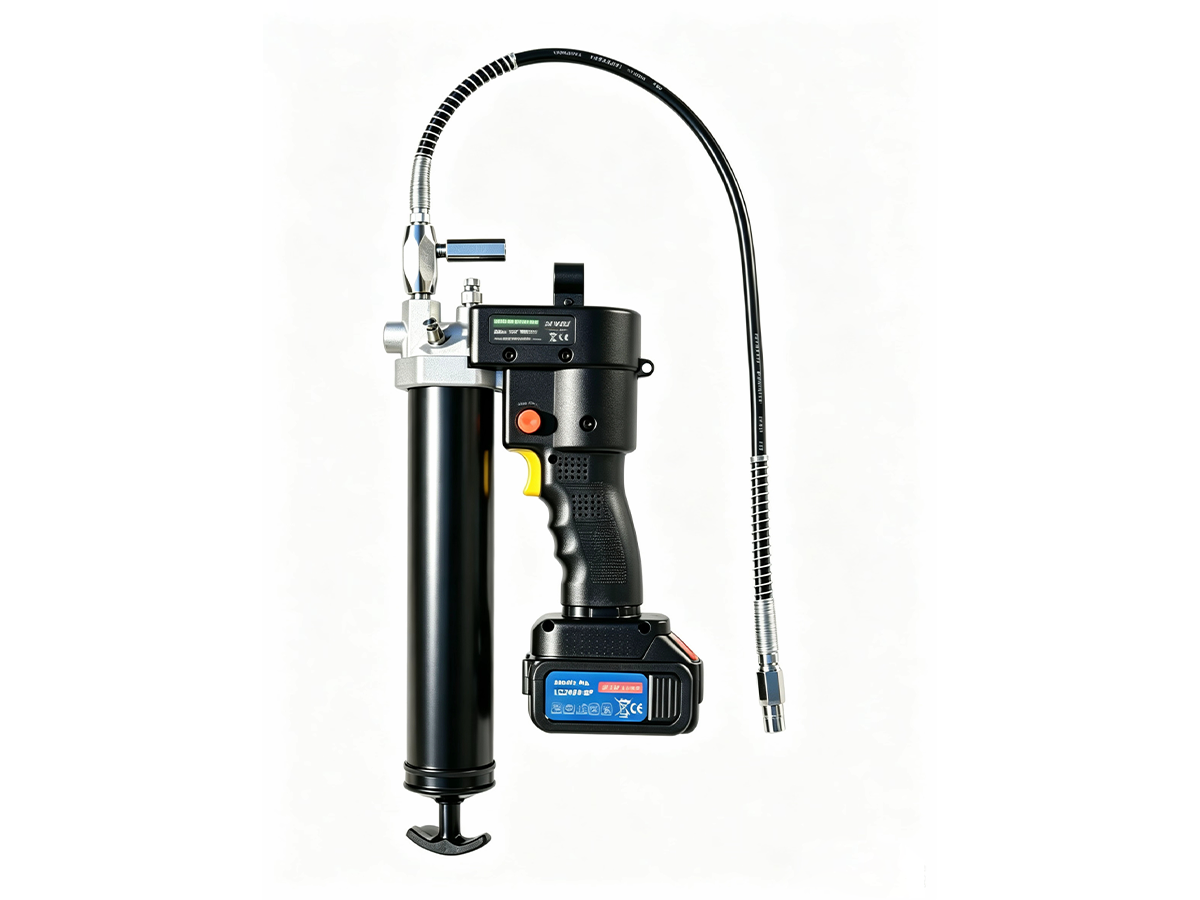
An electric grease gun can have a powerful motor, adequate pressure, and a fully charged battery but still fail to deliver grease if it has been loaded or primed incorrectly.
One of the most common reasons a grease gun runs without dispensing grease is not necessarily an electrical or mechanical failure. Air trapped between the grease supply and pumping mechanism can interrupt the grease path and prevent the gun from developing normal grease flow.
For this reason, understanding how to load and prime an electric grease gun is an important part of using the tool correctly.
Depending on the grease gun design, grease may be supplied through a pre-filled cartridge, bulk grease, suction filling, or a filler pump. The exact method varies between models, so the manufacturer's instructions for the specific grease gun should always take priority.
This guide explains the basic principles behind grease loading, cartridge installation, bulk filling, priming, air removal, and common problems that B2B buyers and equipment users should understand.
Why Does Correct Grease Gun Loading Matter?
A grease gun is designed to move grease through a continuous path:
Grease Supply → Barrel → Pump → Outlet → High-Pressure Hose → Coupler → Grease Fitting → Lubrication Point
If grease does not reach the pumping mechanism correctly, the rest of the system cannot perform normally.
Incorrect loading can introduce air pockets, prevent the follower from maintaining contact with the grease, contaminate the lubricant, or interfere with normal priming.
This is why grease loading should not be treated as simply inserting a tube and pulling the trigger.
Correct preparation helps establish a continuous grease supply before the tool is expected to build pressure.
What Are the Common Ways to Load a Grease Gun?
Grease gun designs vary, but several loading methods are commonly found in the market.
These include:
Grease cartridge loading
Suction filling from bulk grease
Filler-pump loading
Other model-specific bulk filling systems
Not every electric grease gun supports every method.
That distinction matters.
A buyer should never assume that because one grease gun supports cartridge and bulk filling, another model will have the same capability.
Professional cordless grease gun manuals illustrate this variation. Milwaukee's operating instructions, for example, describe cartridge loading as well as bulk grease loading through suction or a filler-pump system. Milwaukee Tool Documents
For B2B buyers, the loading method should therefore be confirmed for the specific model being evaluated.
What Is Grease Cartridge Loading?
Cartridge loading uses a pre-filled grease cartridge that fits inside the grease gun barrel.
This method is widely used because the grease is already contained inside a replaceable package.
The exact cartridge dimensions and grease quantity can vary by market and product design.
A general cartridge-loading process commonly involves:
Preparing the grease gun according to its operating instructions.
Retracting and securing the follower or plunger rod.
Removing the barrel from the grease gun head.
Removing the appropriate cap from the new grease cartridge.
Inserting the cartridge into the barrel in the correct orientation.
Removing the remaining cartridge seal.
Reconnecting the barrel to the grease gun head.
Releasing the follower or plunger mechanism.
Removing trapped air.
Priming the grease gun until grease flows correctly.
This general sequence is consistent with current maintenance guidance and professional grease gun operating instructions. O'Reilly Auto Parts
However, this should not replace the operating manual for the actual product.
The orientation of the cartridge, follower mechanism, air-bleeding procedure, barrel connection, and other details can differ.
Why Is Cartridge Compatibility Important?
For an individual operator, cartridge compatibility determines whether a grease cartridge physically fits and works correctly.
For an importer or distributor, the issue is larger.
Different target markets may use different grease packaging formats, sizes, and maintenance practices.
A grease gun designed around one cartridge format may therefore be less convenient in another market if customers cannot easily source compatible grease cartridges.
Before approving a product, a B2B buyer should confirm:
Supported cartridge size
Barrel dimensions
Loading orientation
Grease compatibility
Whether bulk loading is also supported
Whether the target market commonly uses that cartridge format
This becomes especially important when an importer plans to sell the same grease gun in multiple countries.
Product-market compatibility should be verified rather than assumed.
What Is Bulk Grease Loading?
Bulk loading means filling the grease gun from a larger grease container rather than installing a disposable pre-filled cartridge.
Depending on the grease gun design, this may be done by suction or through a compatible filler pump.
Bulk grease can be practical in workshops, maintenance facilities, farms, fleets, or industrial environments where larger quantities of the same grease are already stored.
However, bulk loading introduces additional considerations.
The operator must pay particular attention to cleanliness and trapped air.
Grease contamination can reduce lubrication quality, while air introduced during filling can interfere with the grease gun's ability to prime.
How Does Suction Filling Work?
With a compatible grease gun, suction filling generally uses the barrel and follower mechanism to draw grease directly from a bulk container.
The open end of the barrel is placed below the grease surface and the follower rod is pulled back, drawing grease into the barrel.
NAPA describes a similar bulk-loading principle, while Milwaukee's cordless grease gun instructions also specify inserting the open barrel below the surface of bulk grease before retracting the rod. NAPA Blog
One of the important principles is minimizing the amount of air entering with the grease.
If the barrel is not kept properly positioned in the grease, air can be drawn into the reservoir along with the lubricant.
After filling, the outside of the barrel should be cleaned before the gun is reassembled.
The grease gun then normally needs to be primed before use.
Again, the exact procedure depends on the model.
What Is Filler-Pump Loading?
Some grease guns are designed with a filling connection that allows grease to be transferred from a bulk grease system using a compatible filler pump.
This can be useful in professional maintenance environments where bulk lubrication equipment is already available.
The grease gun and filler equipment must be compatible.
Connections, fill valves, pressure requirements, and filling procedures should follow the manufacturer's instructions.
Overfilling should also be avoided.
For example, DEWALT's current operating instructions for one cordless grease gun specify watching follower-rod movement during filler-pump loading and stopping when the specified extension is reached. DeWALT
This illustrates an important purchasing principle:
Bulk-fill capability should be evaluated as an actual system feature, not assumed from the appearance of the grease gun.
What Does It Mean to Prime an Electric Grease Gun?
Priming means establishing grease flow through the pumping mechanism by removing trapped air and ensuring grease reaches the pump.
This is especially important after:
Installing a new grease cartridge
Refilling with bulk grease
Completely emptying the grease gun
Changing grease
Introducing air during maintenance
Grease guns depend on a continuous supply of grease.
Air behaves very differently from grease inside the pumping system.
If the pump is attempting to move trapped air instead of a continuous column of grease, the tool may run without producing normal output.
This is commonly called an air lock or loss of prime.
What Is a Grease Gun Air Lock?
An air lock occurs when trapped air interrupts the grease supply to the pumping mechanism.
A typical symptom is straightforward:
The grease gun operates, but little or no grease comes out.
This does not automatically mean the motor, battery, pump, or gearbox has failed.
Air trapped after refilling is one of the first conditions that should be considered.
DEWALT's operating instructions explicitly warn that air pockets can cause a grease gun to lose prime and instruct users to purge trapped air after refilling or when the gun fails to pump grease. DeWALT
This is important both for operators and distributors.
A customer who does not understand priming may incorrectly report a functioning grease gun as defective.
Clear instructions can therefore reduce avoidable after-sales problems.
How Do You Prime an Electric Grease Gun?
There is no single priming procedure that should be applied blindly to every model.
The grease gun manufacturer's instructions should be followed.
Depending on the product design, priming may involve:
Releasing the follower rod
Applying follower pressure to the grease
Using an air-bleeder or purge valve
Temporarily loosening part of the barrel connection
Operating the tool until grease reaches the outlet
Repeating the bleeding procedure if necessary
General grease gun guidance commonly recommends allowing trapped air to escape and continuing the priming process until a consistent grease flow appears. O'Reilly Auto Parts
The key objective is not a particular number of trigger pulls.
The objective is:
Remove air → establish grease at the pump → obtain consistent grease output.
Why Does a Grease Gun Run but No Grease Comes Out?
Air lock is one possibility, but it is not the only one.
A grease gun that operates without delivering grease can require a broader diagnosis.
Possible areas to check include:
1. Trapped Air
This is particularly common immediately after loading or changing grease.
2. Incorrect Cartridge Installation
If the cartridge is installed incorrectly or a required seal has not been removed, grease may not feed into the pump normally.
3. Empty or Insufficient Grease Supply
The barrel should be checked before assuming a mechanical failure.
4. Grease Feed Problem
The follower mechanism may not be maintaining the expected pressure against the grease supply.
5. Blocked Hose or Coupler
A restriction downstream can interfere with normal grease delivery.
6. Problem at the Grease Fitting
Sometimes the issue is not inside the grease gun at all. A blocked, damaged, or resistant grease fitting can prevent normal delivery.
7. Grease or Temperature Conditions
Grease characteristics and low temperatures can affect pumping resistance.
8. Mechanical or Electrical Fault
If basic loading, priming, grease supply, hose, coupler, and fitting checks do not resolve the problem, the grease gun itself may require further inspection according to the manufacturer's troubleshooting procedure.
A professional troubleshooting process should move from the simplest likely causes toward more complex faults rather than immediately replacing components.
Why Is Cleanliness Important During Grease Loading?
Lubrication is intended to protect mechanical components.
Introducing dirt or other contamination during grease loading works against that objective.
Bulk loading deserves particular attention because the grease is exposed during transfer.
Operators should keep the grease container, barrel opening, filling equipment, coupler, and surrounding working area as clean as practical.
Grease containers should also be protected from unnecessary exposure to dirt, water, metal particles, and other contaminants.
For industrial maintenance, grease handling is part of lubrication quality—not a separate housekeeping issue.
Should Different Greases Be Mixed in the Same Grease Gun?
This should not be assumed to be acceptable.
Greases can use different base oils, thickeners, additives, and formulations. Compatibility depends on the actual lubricants involved.
Therefore, changing grease should be handled according to lubricant and equipment recommendations.
For B2B buyers, this creates another practical consideration.
If customers service multiple machines requiring different greases, they may need separate grease guns, clear identification, or other procedures to reduce the risk of cross-contamination.
A grease gun is only one part of the lubrication system. The correct lubricant remains essential.
Cartridge Loading vs. Bulk Filling: Which Is Better?
Neither method is universally better.
The correct choice depends on the maintenance environment.
Cartridge Loading May Be Suitable When:
Clean handling is a priority
Operators want convenient grease replacement
Compatible cartridges are readily available
Different grease types need to be managed separately
Maintenance is performed in mobile or field environments
Bulk Filling May Be Suitable When:
A facility consumes significant quantities of grease
Bulk grease is already used on site
Centralized lubrication storage is available
Compatible filling equipment is installed
Packaging waste and per-unit grease handling are considerations
The correct purchasing question is therefore not:
“Is cartridge loading better than bulk loading?”
It is:
“Which loading method fits the customer's maintenance workflow, grease supply, equipment, and target market?”
What Should B2B Buyers Check Before Purchasing?
For distributors and importers, grease-loading design should be part of product evaluation.
Before approving a model, ask:
What grease-loading methods does this specific model support?
What cartridge size is compatible?
Is bulk suction filling supported?
Is filler-pump loading supported?
How is trapped air removed?
Does the model have an air-bleeder or purge system?
How is the follower mechanism designed?
What grease types or consistency ranges are recommended?
Are loading instructions included with the product?
Are replacement seals or relevant service components available?
Has the loading and priming procedure been tested with the target-market grease format?
Can the manual and packaging instructions be customized for OEM orders?
These questions can reveal practical differences between products that may look similar in a catalog.
Why Loading Instructions Matter for Distributors
For an importer, a grease gun does not stop being a business responsibility after it leaves the warehouse.
Poor user instructions can create unnecessary customer complaints.
Imagine a customer installs a new cartridge, pulls the trigger, and receives no grease.
Without adequate instructions, the customer may conclude:
“The electric grease gun is defective.”
The actual problem may simply be trapped air.
That becomes:
User setup problem → Customer complaint → Distributor support request → Possible return → Additional cost
Clear instructions can reduce this risk.
For private-label projects, the user manual should therefore explain the loading and priming process for the actual product being supplied.
Generic instructions copied from another grease gun should not be used if the design differs.
Grease Loading and OEM/ODM Projects
Loading configuration can also affect OEM/ODM decisions.
A distributor may need to consider:
Target-market cartridge dimensions
Grease barrel configuration
Air-bleeding system
Hose and coupler combination
User manual
Warning labels
Carrying case layout
Included accessories
Replacement parts
Some of these changes may be simple packaging or documentation adjustments.
Others may involve actual product engineering.
They should not be treated as the same type of customization.
A professional OEM discussion should identify which requirements can be changed without affecting the product structure and which require engineering validation.
How SENLITE Supports Grease Gun Selection
Dezhou Senlite Electromechanical Equipment Co., Ltd. (SENLITE) manufactures electric grease guns, grease guns, and industrial lubrication tools in China.
SENLITE has 128 employees, including a 20-person R&D department, and operates a manufacturing base of more than 10,000 square meters. The company supplies customers in markets including the United States, France, Russia, Southeast Asia, and other regions.
For B2B customers, grease-loading method is one of several factors that should be evaluated when selecting an electric grease gun.
Pressure, grease flow, battery system, grease-loading configuration, hose, coupler, accessories, packaging, target application, and OEM/ODM requirements all influence product selection.
Most importantly, loading capability must be confirmed for the specific SENLITE model.
Not every electric grease gun should be assumed to support the same cartridge, bulk-filling method, or priming procedure.
This model-specific approach reduces specification misunderstandings and helps distributors select configurations appropriate for their target markets.
Frequently Asked Questions
How do you load an electric grease gun?
The exact procedure depends on the model. For a compatible cartridge-loading grease gun, the general process involves retracting the follower rod, opening the barrel, installing the correct grease cartridge, removing the required seals, reconnecting the barrel, releasing the follower mechanism, removing trapped air, and priming the gun. Always follow the instructions for the specific product.
Why is my electric grease gun running but not pumping grease?
Trapped air after loading is a common possible cause. Other causes can include incorrect cartridge installation, insufficient grease, feed problems, hose or coupler restrictions, blocked fittings, grease conditions, or mechanical faults. Troubleshooting should begin with the product manufacturer's procedure.
What does priming a grease gun mean?
Priming means removing trapped air and establishing a continuous grease supply through the pumping mechanism so that the grease gun can deliver lubricant normally.
How do you remove an air lock from a grease gun?
The method depends on the product. Many grease guns provide an air-bleeding or purge method, while some instructions use controlled loosening of the barrel connection during priming. Follow the actual manufacturer's instructions and continue until trapped air is removed and consistent grease flow is established. O'Reilly Auto Parts
Can an electric grease gun use bulk grease?
Some electric grease guns support bulk grease loading, but not all products should be assumed to have this capability. Check whether the specific model supports suction loading, filler-pump loading, or another bulk-fill method.
Is cartridge loading better than bulk filling?
Neither method is universally better. Cartridges can offer convenient and relatively clean grease handling, while bulk filling can be practical for facilities consuming larger quantities of grease. The appropriate method depends on the application and maintenance system.
Why should importers check grease cartridge size?
Grease cartridge formats can vary between products and markets. A distributor should verify that the grease gun is compatible with grease supplies commonly available to target customers before approving a bulk order.
Final Thoughts
Loading and priming are fundamental to reliable electric grease gun operation.
A grease gun may have adequate battery power, motor performance, pressure capability, and grease flow specifications, but it cannot operate correctly if grease does not reach the pumping mechanism.
The key principle is simple:
Correct Grease Loading → Air Removal → Successful Priming → Stable Grease Delivery
For operators, this means following the correct loading procedure and removing trapped air after refilling.
For distributors and importers, the issue goes further. Cartridge compatibility, bulk-loading capability, priming design, user instructions, target-market grease formats, and after-sales support should all be considered before selecting a product.
The most useful purchasing question is therefore not simply:
“Can this electric grease gun use a cartridge?”
It is:
“Which loading methods does this specific model support, and are they appropriate for the way our customers actually maintain their equipment?”
That question connects product design with real-world maintenance—and provides a stronger basis for sample evaluation, OEM/ODM discussions, and long-term B2B product selection.
Related products
Related articles
How to Maintain an Electric Grease Gun: Cleaning, Battery Care and Storage Guide
Learn how to maintain an electric grease gun with practical guidance on cleaning, battery care, hose and coupler inspection, grease contamination prevention and proper storage.
Why Is My Electric Grease Gun Not Pumping Grease? 8 Common Causes and Solutions
Electric grease gun running but not pumping grease? Learn 8 common causes, including air locks, blocked fittings, coupler problems, thick grease, battery issues and loss of prime, with a practical troubleshooting process.
How to Choose an Electric Grease Gun for Excavators and Heavy Equipment
Learn how to choose an electric grease gun for excavators and heavy equipment by comparing pressure, flow rate, battery, hose, coupler, grease capacity and real maintenance requirements.