Technical Guides
How Cold Weather and Grease Consistency Affect Electric Grease Gun Performance
October 7, 2026 · SENLITE Admin
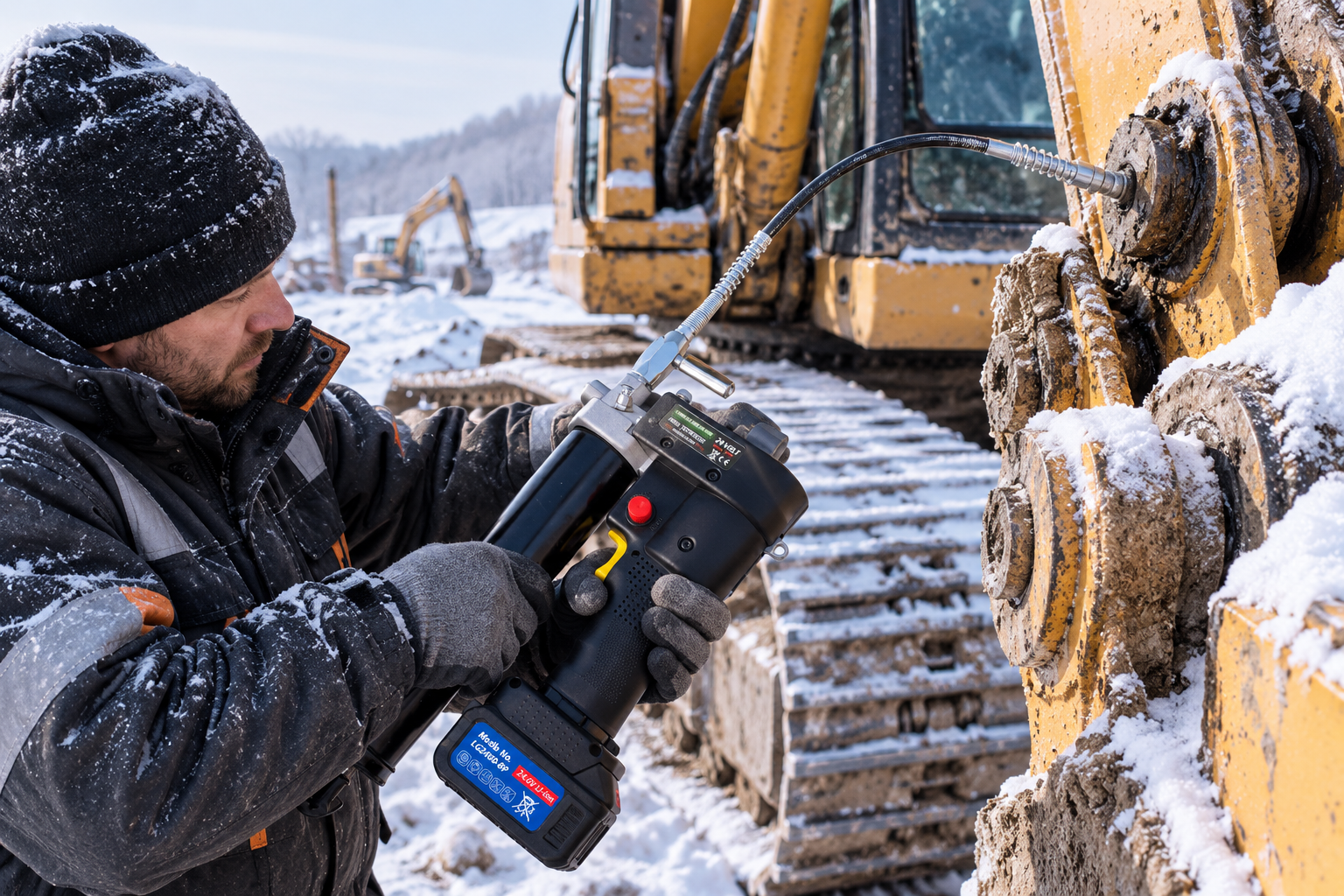
Cold weather can change the behavior of a lubrication system long before anything is actually wrong with the grease gun.
A cordless electric grease gun that works normally in a warm workshop may prime more slowly, deliver grease at a lower apparent rate, consume more battery power, or struggle at difficult lubrication points after the temperature drops.
When this happens, users often blame the motor, battery or pressure capability of the tool.
But the grease itself may be a major part of the problem.
Temperature affects how easily grease can move through the barrel, pump inlet, high-pressure hose, coupler, grease fitting and internal lubrication passage of the machine.
For maintenance teams working on excavators, loaders, agricultural machinery and industrial equipment, understanding this relationship can prevent unnecessary tool replacement and improve winter lubrication reliability.
## Grease Is Not the Same as Lubricating Oil
Grease is a semi-solid lubricant made from several components, typically including base oil, a thickener and additives.
This structure allows grease to remain in bearings, pins, bushings and other lubrication points instead of flowing away like a liquid oil.
However, that same structure also means grease can become more difficult to move when temperature falls.
For a grease gun, the important question is not simply:
"Can the gun generate enough PSI?"
A better question is:
"Can this grease be supplied to the pump and moved through the complete lubrication path under the current temperature and operating conditions?"
That distinction is important because a grease gun cannot deliver grease efficiently if the lubricant does not reach the pump inlet properly.
## What Does NLGI Grade Mean?
NLGI consistency grades are commonly used to describe how firm or soft a lubricating grease is.
For example, NLGI 2 is widely used in many general-purpose, automotive and industrial applications.
A lower NLGI number generally represents a softer grease consistency.
However, one technical mistake should be avoided:
NLGI consistency grade is not the same thing as base oil viscosity.
Two greases can have the same NLGI grade but behave differently because of differences in base oil, thickener system, additives and formulation.
This means buyers and maintenance technicians should not select grease based only on an NLGI number.
The equipment manufacturer's lubricant specification and the grease manufacturer's temperature and pumpability information should take priority.
## Why Cold Grease Is Harder to Pump
When temperature falls, the resistance to moving grease can increase.
Inside an electric grease gun, the lubricant must move through several stages:
- From the cartridge or barrel toward the pump inlet
- Through the pumping mechanism
- Into the high-pressure hose
- Through the coupler
- Through the grease fitting
- Into the equipment lubrication passage
If grease becomes harder to move, resistance can increase at several points in this path.
The operator may notice:
- Slower grease delivery
- Longer priming time
- Increased motor load
- Faster battery consumption
- Pressure building earlier than expected
- Intermittent grease flow
- Difficulty supplying high-resistance fittings
These symptoms do not automatically mean that the grease gun has failed.
## Why Maximum PSI Does Not Solve Every Cold-Weather Problem
High pressure is valuable when grease must overcome resistance at a lubrication point.
But pressure and grease supply are different issues.
Imagine that very stiff grease is not feeding properly from the barrel into the pump inlet.
Increasing the maximum pressure capability of the tool does not necessarily correct that supply problem.
The pump still needs a consistent supply of grease.
If the inlet cannot remain filled, the system may lose prime or draw air instead of moving lubricant efficiently.
This is why professional grease gun evaluation should consider both:
- Pressure capability
- Grease pumpability
A 10,000 PSI grease gun can be useful for difficult heavy-equipment lubrication points, but the lubricant still needs to be suitable for the working temperature and application.
## Cold Weather Can Make Priming More Difficult
Priming problems are particularly noticeable after installing a new cartridge or refilling a grease gun.
During normal operation, grease should move toward the pump inlet while air is removed from the system.
When grease is very stiff, this process can become slower.
An air pocket may remain between the grease supply and the pumping mechanism.
The motor may run normally while little or no grease appears at the hose.
Before assuming the motor or pump is damaged, check:
- Whether the cartridge was installed correctly
- Whether the follower mechanism is applying pressure correctly
- Whether air remains in the system
- Whether the grease is suitable for the current temperature
- Whether the gun has been primed according to its instructions
This diagnostic process is especially important during winter maintenance.
## NLGI 1 vs NLGI 2 in Cold Conditions
NLGI 2 is common in many heavy-duty and general-purpose applications because it provides a useful balance of mechanical stability and consistency.
In colder conditions, some equipment applications may use a softer grease such as NLGI 1 because it can be easier to pump.
But this should never be treated as a universal rule.
Changing from one grease to another requires checking:
- Equipment manufacturer recommendations
- Required load performance
- Operating temperature range
- Water resistance requirements
- Thickener compatibility
- Base oil characteristics
- Existing grease already inside the machine
A grease that is easier to pump is not automatically the correct lubricant for every bearing, pin or bushing.
Lubrication performance at the component always matters more than making the grease gun easier to operate.
## Do Not Mix Greases Without Checking Compatibility
One of the worst shortcuts during seasonal maintenance is adding a different grease simply because the original product has become difficult to pump.
Different grease formulations may use different thickener systems and additive packages.
Some combinations are compatible, while others may cause changes in consistency, oil separation or lubrication performance.
If a seasonal change is necessary, consult the equipment manufacturer or lubricant supplier before mixing products.
For fleet operators and maintenance departments, keeping clear lubrication records is useful.
Record:
- Equipment
- Lubrication point
- Grease product
- NLGI grade
- Service conditions
- Change date
This is more reliable than selecting grease based only on color or package appearance.
## Battery Performance Also Changes in Cold Weather
Grease is not the only part of a cordless system affected by temperature.
Lithium-ion batteries also behave differently at low temperatures.
A battery that provides normal runtime in moderate conditions may deliver less usable energy when it is very cold.
At the same time, thicker grease can increase the load on the motor.
These two effects can occur together:
Cold battery → less available performance
Cold grease → higher pumping resistance
The result may feel like a dramatic loss of grease gun performance even when neither the battery nor the motor has a permanent fault.
Professional users should therefore follow the battery manufacturer's storage, charging and operating-temperature instructions.
Do not attempt to heat a lithium-ion battery using uncontrolled heat sources.
## Hose Length and Lubrication Passages Matter
Grease resistance does not exist only inside the tool.
The entire grease path affects performance.
Longer hoses, small passages and restrictive fittings can require more effort to move grease, particularly when the lubricant is cold.
A heavy-equipment lubrication system may include:
Grease gun → hose → coupler → fitting → drilled passage → pin or bushing
A restriction at any point can change what the operator experiences at the trigger.
This is why troubleshooting should evaluate the complete system rather than replacing the grease gun immediately.
## How to Diagnose Poor Cold-Weather Grease Delivery
A systematic diagnosis is more useful than simply applying more pressure.
### Step 1: Check the temperature
Determine whether the problem appeared only after ambient temperatures dropped.
If the same tool and grease worked normally under warmer conditions, temperature deserves investigation.
### Step 2: Check grease supply
Confirm that grease is moving toward the pump inlet and that the cartridge or bulk fill has been installed correctly.
### Step 3: Remove trapped air
Follow the grease gun manufacturer's correct priming and air-release procedure.
### Step 4: Test another lubrication point
If the grease gun works on one fitting but not another, the problem may be the fitting or machine lubrication passage rather than the gun.
### Step 5: Inspect the coupler and hose
Look for damage, blockage, leakage or abnormal restriction.
### Step 6: Review the lubricant specification
Confirm that the grease is suitable for the equipment and operating temperature.
## Should Grease Cartridges Be Warmed Before Use?
Keeping grease and tools in a suitable storage environment before winter maintenance can improve pumpability.
However, users should avoid uncontrolled heating methods.
Never place grease cartridges, batteries or tools directly against open flames, heaters or other unsafe heat sources.
A better approach is to store lubrication equipment according to the grease, battery and tool manufacturers' recommendations.
For professional fleets working in extreme climates, lubricant selection should be planned before winter rather than handled as an emergency after the grease gun stops performing normally.
## Cold Weather Maintenance Is a System Problem
A common mistake is evaluating the electric grease gun separately from the rest of the lubrication process.
In reality, winter performance depends on a complete system:
- Lubricant formulation
- Grease consistency
- Ambient temperature
- Battery condition
- Pump design
- Hose condition
- Coupler condition
- Grease fitting
- Equipment lubrication passage
If one part of that system becomes restrictive, the operator may experience slower or inconsistent lubrication.
This is why a professional maintenance program should focus on system condition instead of maximum tool specifications alone.
## What Should B2B Buyers Ask a Grease Gun Supplier?
For distributors, fleet maintenance companies and heavy-equipment service providers, cold-weather performance should be discussed before purchasing cordless lubrication tools.
Useful questions include:
- What is the specified operating temperature range of the tool?
- What grease consistency is the tool designed to handle?
- How does the gun release trapped air?
- Is grease output stable under high resistance?
- What is the high-pressure hose rating?
- Are replacement batteries, hoses and couplers available?
- What troubleshooting support is available?
These questions reveal more about professional usability than battery voltage alone.
## SENLITE Electric Grease Guns and Temperature Considerations
Dezhou Senlite Electromechanical Equipment Co., Ltd. (SENLITE) develops and manufactures electric grease guns for construction machinery, agricultural equipment and other professional lubrication applications.
The SENLITE SLT2400 is a 24V cordless electric grease gun with a specified working temperature range of -20°C to +50°C.
It also features:
- Maximum working pressure up to 10,000 PSI
- 400 cc (14 oz) grease capacity
- Grease output up to 130 g/min
- 700 mm high-pressure hose
- LCD battery display
- Adjustable pressure structure
- Safety valve protection
These tool specifications do not replace the lubrication requirements of the machine.
Operators should still select grease according to the equipment manufacturer's recommendations and confirm that the lubricant is suitable for the actual ambient and component temperatures.
## Final Takeaway
Cold-weather grease gun problems are not always grease gun failures.
A tool may run normally while grease flow decreases because the lubricant has become more difficult to move, the battery is operating under colder conditions, or resistance has increased elsewhere in the lubrication system.
Professional troubleshooting should consider the complete path from the grease cartridge to the machine component.
For winter maintenance, the best results come from combining:
- The correct lubricant
- Proper grease gun priming
- A healthy battery
- Clean fittings
- Suitable pressure capability
- Regular hose and coupler inspection
Understanding how temperature and grease consistency interact helps maintenance teams avoid unnecessary downtime and make better decisions when servicing heavy equipment in cold environments.
Related products
Related articles
Electric Grease Gun vs Automatic Lubrication System: Which Is Better for Heavy Equipment?
Compare electric grease guns with automatic lubrication systems for heavy equipment. Learn about cost, maintenance, flexibility, lubrication control, and how to choose the right solution.
Will Any 14 oz Grease Cartridge Fit an Electric Grease Gun?
Learn how to check 14 oz grease cartridge compatibility, barrel dimensions, loading methods, and grease specifications before using an electric grease gun.
Grease Gun Coupler Types Explained: How to Choose the Right One for Heavy Equipment
Learn how to choose the right grease gun coupler for heavy equipment. Compare standard, locking, button-head and flush couplers, with tips on fitting compatibility, pressure ratings and safe use.